RU
 ZH
 IT
 ES
 TR
 JA
 PT
 KO
 FR
 DE
 AR
 ID

Automated store with touch screen
Learn More



Touch panel performance depends on more than the controller or the software running behind the display. The materials inside the touch panel also affect how reliably it detects input, how well it withstands repeated use, and how consistently it performs in different working environments. For equipment manufacturers, understanding these material choices is an important part of designing a dependable touch interface.
In a four-wire resistive touch screen, indium tin oxide (ITO) provides the conductive surfaces needed to detect touch through physical pressure. The conductive layers can be arranged using ITO film and ITO glass or two ITO-coated films, depending on the panel design. Each structure has characteristics that influence mechanical construction, surface performance, and integration requirements. Selecting the right configuration helps equipment designers match the touch panel to the intended application rather than relying on screen size alone.
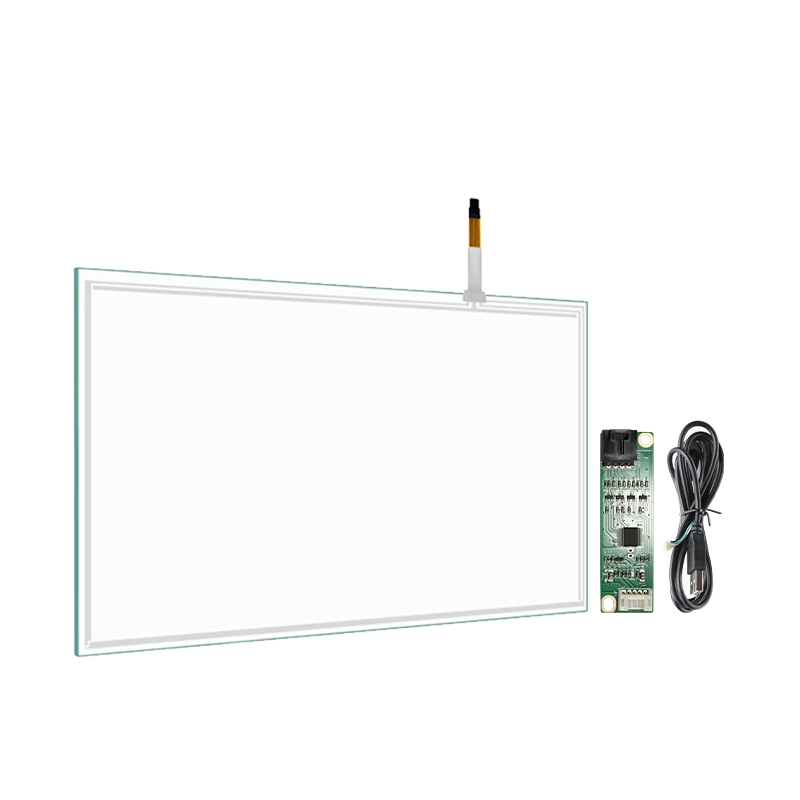
ITO is a transparent conductive material widely used in touch-sensitive components. It allows a surface to transmit visible light while providing the electrical properties required to detect contact. In a four-wire resistive touch panel, two conductive layers are separated by a small gap. When a user presses the screen, the layers make contact, allowing the controller to determine the touch position from changes in electrical voltage.
One common structure combines an ITO-coated film with an ITO-coated glass layer. Another uses ITO film on both conductive surfaces. Although both arrangements follow the same basic resistive sensing principle, their physical construction differs.
An ITO film layer provides a flexible conductive surface that can deflect under pressure. An ITO glass layer provides a rigid base that supports the panel structure. The film-and-glass combination is therefore a practical option for equipment requiring a firm backing and a pressure-sensitive upper surface.
A film-and-film construction uses flexible substrates on both sides. Its suitability depends on the equipment's mechanical requirements, surface treatment, and intended operating conditions. Neither structure should be treated as universally superior; the appropriate choice depends on the complete touch panel design.
For buyers evaluating a Resistive Touch Screen 10.4 to 22 Inches (4 Wire), confirming the layer construction at the specification stage helps prevent mismatches between the touch panel and the equipment enclosure.
The conductive layers work together to register physical input, but the panel's overall performance also depends on the quality of its materials, electrical connections, spacing, and assembly.
In normal operation, pressure brings the conductive surfaces into contact at a particular point. The controller measures the resulting electrical changes and converts them into coordinates. Stable electrical behavior and consistent mechanical construction help the system register input predictably.
Several factors deserve attention during technical evaluation:
Conductive layer consistency: Variations in the conductive coating can affect electrical behavior across the active area.
Layer spacing: The separation between the conductive surfaces must allow normal operation while preventing unwanted contact when the screen is not pressed.
Surface condition: Scratches, contamination, and coating defects can affect usability and may compromise the intended service conditions.
Bonding and alignment: Inconsistent assembly can lead to uneven performance or visible defects.
Controller compatibility: The touch panel must work with the selected controller and the host system's input configuration.
These factors should be evaluated together rather than treating ITO material selection as an isolated decision. A well-chosen substrate cannot compensate for poor bonding, unsuitable controller settings, or an incorrectly designed mounting structure.
The choice between film-and-glass and film-and-film construction should begin with the mechanical requirements of the finished equipment.
Film-and-glass construction provides a rigid glass backing and a flexible upper conductive layer. This arrangement is commonly considered when designers need a stable panel structure with pressure-based touch input. The glass substrate also creates specific requirements for thickness, handling, and mechanical support.
Film-and-film construction uses flexible substrates on both sides. Depending on the design, it may be appropriate for projects with different mechanical or structural priorities. However, its flexibility does not automatically make it more durable or suitable for every enclosure.
When comparing the two, equipment developers should consider the following questions:
Does the installation require a rigid backing or a particular level of structural flexibility?
What are the allowable panel thickness and mounting tolerances?
Will the touch surface be exposed to repeated contact, cleaning, or potential abrasion?
Does the project require a matte finish, anti-glare treatment, or anti-Newton ring treatment?
Are there specific optical or electrical requirements that must be verified before production?
The answers help narrow the appropriate construction and identify which details need confirmation with the manufacturer. Material selection should be based on the complete assembly rather than assumptions about one substrate being better in all circumstances.
ITO layers are only part of the material system. The outer surface also influences how a resistive touch screen performs during everyday operation.
Repeated finger contact, stylus input, cleaning, and accidental contact with surrounding objects can gradually affect the touch surface. A suitable hard coating helps address surface wear, while a matte finish or anti-glare treatment can be selected according to the visual and operational requirements of the equipment.
The Resistive Touch Screen 10.4 to 22 Inches (4 Wire) series offers a surface treatment option involving a matte hard coating and anti-Newton ring treatment. These features address different concerns: hard coating is associated with surface protection, while anti-Newton ring treatment helps reduce interference patterns that may appear between closely spaced surfaces.
The product specification also identifies pencil hardness of 3H according to ASTM D3363. Pencil hardness is a test-based indication of resistance to surface marking under defined conditions. It should not be interpreted as a guarantee against every type of scratch, impact, or abrasive cleaning method.
For equipment used in production areas, laboratories, or commercial environments, the intended cleaning method and contact frequency should be considered when specifying the surface finish. Buyers should also confirm whether the required finish is standard or needs to be customized for the project.
Industrial touch panels may be installed in environments where dust, oil, water, or moisture is present. These conditions make the overall panel design important, particularly when the touch interface forms part of a control cabinet or enclosed machine.
Resistive touch technology detects input through pressure, which can be useful for equipment that must accept different forms of physical input. However, the ability to operate in a contaminated environment depends on more than the sensing principle. Surface condition, sealing, installation, cable routing, and enclosure design all contribute to the final result.
The product information for GreenTouch's four-wire series identifies sealing options associated with NEMA 4, 4X, and 12 requirements. Buyers should confirm the exact model configuration, mounting arrangement, and applicable test or compliance documentation before specifying a protection level for the finished equipment. A touch panel's stated capability should not automatically be taken as certification of the complete machine or enclosure.
Environmental customization may also include high-temperature, high-humidity, and anti-UV requirements. These should be discussed early in the design process so that the manufacturer can confirm the available construction, materials, and validation requirements.
Material construction is only one part of touch panel selection. The screen's dimensions and aspect ratio must also fit the equipment's mechanical layout and user interface.
The GreenTouch range covers multiple sizes from approximately 10.4 inches to 22 inches, with configurations available across 4:3, 16:9, and 16:10 aspect ratios. Common options include 10.4-inch, 12.1-inch, 15-inch, 17-inch, 19-inch, 21.5-inch, and 22-inch panels, subject to the specific model and configuration.
A 4:3 panel may suit equipment designed around a more traditional display layout. A 16:9 panel may fit a wider interface, while a 16:10 panel can provide a different balance between horizontal and vertical working space. These are layout considerations rather than fixed rules, so the final choice should follow the display, enclosure, and software requirements.
Before placing an order, engineers should confirm the active touch area, overall dimensions, mounting tolerances, FPC outlet location, cable routing, and glass thickness. These details can affect mechanical compatibility even when two panels have the same nominal diagonal measurement.
A properly selected touch panel must also communicate reliably with the target system. GreenTouch four-wire resistive touch screens can be integrated with suitable controllers and host platforms running Windows, Android, or Linux.
The connection process described for the product series involves connecting the extension ribbon cable to the driver board, connecting the touch screen cable, and then connecting the driver board through USB. The exact arrangement depends on the supplied controller and project configuration, so the connection diagram for the selected model should be followed during installation.
Compatibility checks should cover the controller interface, driver support, coordinate mapping, mounting orientation, and the host system's input handling. A panel that is electrically compatible may still require configuration to match the application's coordinate system or physical screen orientation.
For OEM projects, it is useful to confirm these details before finalizing the enclosure or ordering production quantities. This approach reduces the risk of late-stage changes involving cables, connectors, or mounting components.
The performance of a resistive touch panel depends on both material selection and manufacturing consistency. Coating quality, substrate handling, bonding conditions, and inspection procedures can influence the uniformity of the finished product.
ShenZhen GreenTouch Technology Co., Ltd. manufactures touch products including resistive and capacitive touch screens, infrared touch frames, touch monitors, and touch-enabled all-in-one systems. The company reports having a Class 1,000 dust-free lamination workshop, bonding capabilities covering G+G, G+FF, and TP+LCM full lamination, and a standard production workshop of approximately 5,000 square meters.
These capabilities are relevant when evaluating how a manufacturer handles panel assembly and production. GreenTouch also reports ISO 9001 quality management system and ISO 14001 environmental management system certifications, alongside product certification coverage that includes CE, FCC, and RoHS for applicable products.
When comparing manufacturers, buyers should request information that directly relates to their project: inspection coverage, acceptance criteria, sample validation, batch consistency, and documentation for the selected configuration. General factory capabilities are useful background, but model-specific verification remains essential.
A reliable selection process starts with the equipment's actual requirements. Engineers should identify the substrate structure, surface treatment, dimensions, interface, environmental conditions, and expected usage before requesting a sample or quotation.
The following checklist can help organize the specification:
Material structure: ITO film plus ITO glass, or ITO film plus ITO film.
Size and aspect ratio: Match the active area and mechanical dimensions to the equipment.
Surface finish: Confirm hard coating, matte or anti-glare options, and anti-Newton ring requirements.
Electrical interface: Verify the controller, FPC outlet position, cable arrangement, and host system.
Environmental requirements: Specify temperature, humidity, UV exposure, cleaning conditions, and applicable sealing needs.
Validation: Confirm the test methods, inspection criteria, and supporting documents required for approval.
For projects with special mechanical or environmental requirements, GreenTouch offers customization options covering appearance, electrical interfaces, structural design, glass thickness, and cable outlet location. Buyers should provide drawings and operating conditions early enough for the proposed design to be reviewed before production.
The right Resistive Touch Screen 10.4 to 22 Inches (4 Wire) is not simply the panel that matches a required diagonal size. It is the configuration whose conductive layers, surface treatment, controller, and mounting details work together within the finished equipment. By evaluating these elements as a complete system, equipment manufacturers can make more informed material decisions and reduce avoidable integration issues.