 RU
RU ZH
ZH IT
IT ES
ES TR
TR JA
JA PT
PT KO
KO FR
FR DE
DE AR
AR ID
ID
The Difference between LED and LCD
Learn More



A floor standing display becomes more useful when people can interact with the information instead of simply looking at it. In places such as shopping malls, hotels, government service halls, transportation hubs, exhibition venues, and medical institutions, users may need to browse several options, check directions, find service information, or select content on the screen. This is where responsive touch interaction can make a practical difference.
The Floor Standing Touch Digital Signage 32-65 Inches (6C Series) is designed for this type of interactive information display. Available in 32-inch, 43-inch, 50-inch, 55-inch, and 65-inch configurations, the 6C Series combines a large-format LCD display, projected capacitive touch technology, Android operating systems, and a floor standing structure. Its 10-point capacitive touch function allows the screen to recognize multiple touch points, providing a more flexible interface for interactive applications.
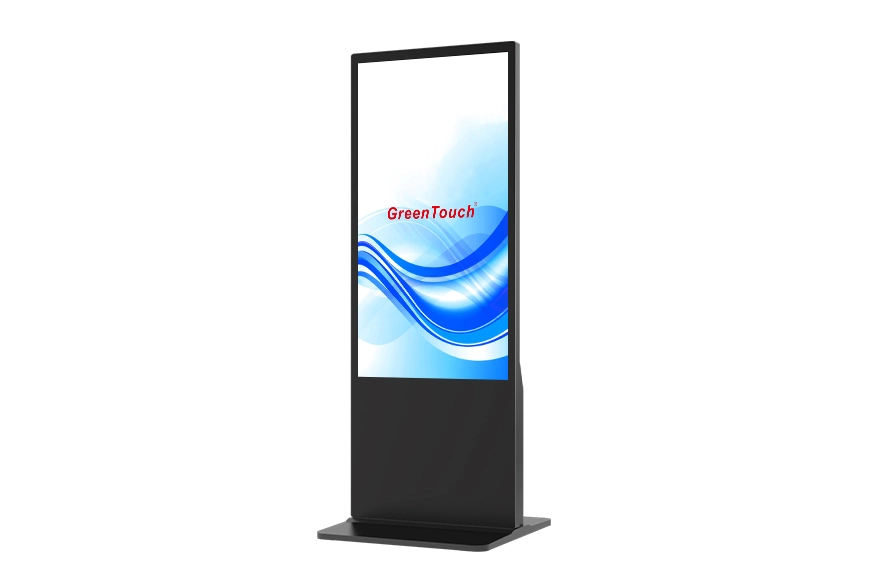
A floor standing digital signage system is often installed where different users interact with the same screen throughout the day. A single-touch interface can handle basic selections, but more complex interfaces may require gestures such as dragging, zooming, stretching, or rotating visual content.
The 6C Series supports 10-point projected capacitive touch, with sensitive touch detection and accurate positioning. This makes it suitable for interactive maps, product catalogs, digital directories, information queries, and other interfaces where users need to move through content directly on the display.
For example, a shopping mall can use an interactive directory that lets visitors select a store category, enlarge a map, or move between different sections. At an exhibition hall, users can browse product information and enlarge images or diagrams without relying on a separate computer or keyboard.
The advantage is not simply the number of touch points. The touch capability needs to work together with the display, operating system, processing hardware, and application software to create a usable interactive terminal.
Touch interaction is only effective when users can clearly see what they are selecting. The 6C Series supports UHD 4K or Full HD 1920 × 1080 resolution depending on configuration, providing options for different content requirements and screen sizes.
The display also supports a color depth of 1.07 billion colors and 90% NTSC color coverage. This helps maintain more detailed color reproduction when the signage is used for product images, promotional graphics, maps, cultural content, or other visual materials.
The touch panel is optically bonded to the LCD panel. Combined with the tempered glass front panel, this structure helps create a more integrated display surface. For applications where people need to stand directly in front of the screen and interact with content, the combination of a large viewing area and responsive touch interface is particularly useful.
Traditional signage mainly delivers information in one direction: the screen shows content and the audience views it. A touch-enabled floor standing display can introduce another layer by allowing users to select what they need.
The 6C Series Digital Signage can support several practical functions:
Wayfinding and indoor navigation
Information announcements
Queue and service inquiries
Product and event information
Cultural and exhibition displays
Brand and new product presentations
Interactive catalogs
Public information services
Consider a hotel lobby. Instead of displaying only promotional content, the screen can provide event information, facility guidance, and other useful information that visitors can access through touch. In a government service hall, users can navigate information categories and locate relevant service instructions. In an exhibition hall, visitors can explore different exhibits and enlarge visual materials as required.
This changes the role of the floor standing display from a passive advertising screen into an interactive information terminal.
Touch interaction also places requirements on the internal hardware. The 6C uses the RK3568S processor with a quad-core ARM Cortex-A55 architecture and a maximum clock speed of up to 2.0 GHz. Depending on the configuration, RAM can range from 2 GB to 8 GB, while storage options include 32 GB to 64 GB SSD capacity with TF card support.
This hardware platform provides a practical foundation for running Android-based interactive applications, digital signage software, multimedia content, and touch-enabled interfaces.
The 6C supports Android 11, 12, 13, and 14 configurations. This gives system integrators and project developers more flexibility when matching the display with application requirements.
Connectivity is also designed around common deployment needs. The display provides HDMI, OTG, TF, power, audio, RJ45, and USB interfaces. The ports are located on the rear of the unit and face downward, helping keep cable connections organized when the display is installed in different environments.
For networked applications, the system supports RJ45 100 Mbps Ethernet, 2.4 GHz Wi-Fi with 802.11b/g/n protocols, and Bluetooth 4.2 with Bluetooth file transfer.
Not every digital signage project uses the same content workflow. Some users may update content through a computer, while others may use USB storage or dedicated signage software.
The 6C supports computer connection, USB flash drive playback, and software-based playback. It can also support remote program publishing, split-screen playback, and multi-format content combinations.
This is useful when a single display needs to handle several types of information. For example, one area of the screen can present promotional content while another section displays service information or announcements. Time-segmented playback can also be configured so that different content is shown at different periods.
Timed power-on and power-off functions provide another practical control for installations with defined operating schedules. These functions can help align display operation with the opening hours or service periods of a venue.
The screen surface can affect how the display performs in different environments. The 6C Series supports optional AG, AF, AR, and mirror-face surface treatments.
AG treatment can be considered when glare control is important. AF treatment is relevant where reducing fingerprints and surface contamination is a priority, while AR treatment can help address reflection concerns. The appropriate choice depends on the installation environment, viewing conditions, and cleaning requirements.
This flexibility is particularly useful because a floor standing display may be installed in locations with different lighting conditions. A screen placed in a shopping mall, for example, may face overhead lighting and reflected light from surrounding storefronts, while an exhibition display may have more controlled lighting.
The 6C uses a tempered glass panel with a black metal shell, giving the display a solid floor standing structure suitable for public-facing environments.
The system is also designed for long operating cycles. The specified lifecycle support includes 24/7 usage, with a 1–3 year guarantee depending on the applicable configuration and terms. For digital signage deployed in commercial or public spaces, continuous operation is an important consideration because the display may be expected to remain available for long periods rather than being used only occasionally.
As a touch-product manufacturer, ShenZhen GreenTouch Technology Co.,Ltd. combines touch display development with production capabilities. Its facilities include a Class 1000 dust-free lamination workshop and support G+G, G+FF, and TP+LCM full lamination technologies. The company also has more than 20 technical engineers, a standard 5,000 m² production workshop, and production capacity of more than 600 touch panels per day.
These manufacturing capabilities are relevant when interactive signage is deployed as part of a larger project that may require consistent product configuration and ongoing supply.
The value of 10-point touch depends on the application rather than the specification alone. For a simple advertising loop, touch capability may not be necessary. For information terminals, however, the ability to directly manipulate on-screen content can improve how users access information.
The 32–65 inch size range also gives project planners more options. A 32-inch configuration can suit locations where floor space is limited, while larger 50-inch, 55-inch, or 65-inch displays can provide a wider interface for maps, catalogs, or detailed visual content.
For shopping malls and chain stores, the display can combine promotional content with product browsing and navigation. For hotels, it can provide guest information and venue guidance. For transportation hubs, it can support directional information and service announcements. For exhibitions, it can turn static content into an interactive presentation.
In these scenarios, Floor Standing Touch Digital Signage is not simply replacing a conventional poster or screen. It provides a physical interface through which visitors can choose, explore, and manipulate information.
A useful interactive signage system requires more than adding a touch panel to a large screen. Touch accuracy, display quality, processing performance, operating system support, connectivity, content management, physical structure, and long-term operation all need to work together.
The 6C Series brings these elements into one floor standing platform, combining 10-point projected capacitive touch with Android 11–14, RK3568S processing, multiple connectivity options, flexible playback functions, and 32–65 inch display configurations.
For projects that require users to actively browse information rather than simply view a promotional loop, the Floor Standing Touch Digital Signage 32-65 Inches (6C Series) provides a practical platform for building interactive information displays across commercial, public, hospitality, transportation, exhibition, and institutional environments.