 RU
RU ZH
ZH IT
IT ES
ES TR
TR JA
JA PT
PT KO
KO FR
FR DE
DE AR
AR ID
ID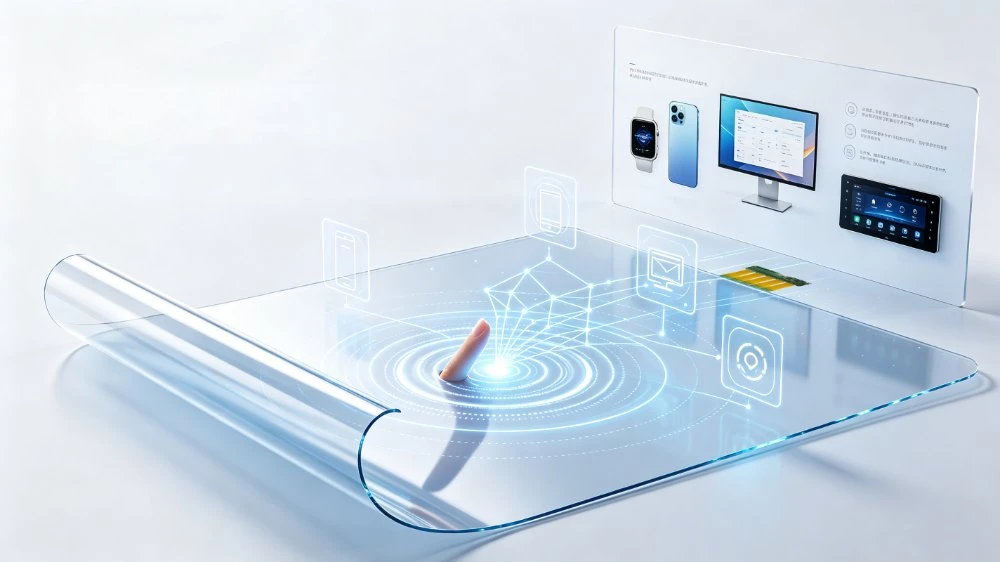
Pushing the Boundaries of Touch Technology! GreenTouch XT Series PcapTouch Films Empower Smart Interaction Across All Scenarios
Learn More



Curved and irregular display surfaces are becoming more common in museums, retail environments, corporate showrooms, public information systems, exhibitions, and immersive digital installations. However, turning a non-flat screen into a reliable interactive display is more complicated than simply adding a conventional touchscreen panel.
This is where Interactive Touch Foil 43 to 180 Inches (XTC Series)provides a practical approach. Instead of replacing the display with a dedicated touchscreen panel, the ultra-thin capacitive film can be integrated onto the back of glass, acrylic, or polycarbonate surfaces. It supports both straight and curved applications while keeping the original display surface visually clean and borderless.
Traditional touchscreen displays are generally designed around rigid, flat structures. This works well for standard monitors, kiosks, and all-in-one computers, but it can become restrictive when an installation requires a curved surface.
A curved display may be selected for several reasons. Retailers may want a more distinctive product presentation. Museums and exhibitions may use curved screens to create a more immersive visitor experience. Control rooms and professional environments may require a customized interface that follows the physical structure of the equipment.
In these applications, installing a conventional touchscreen module can involve mechanical redesign, additional bezels, or complicated integration work.
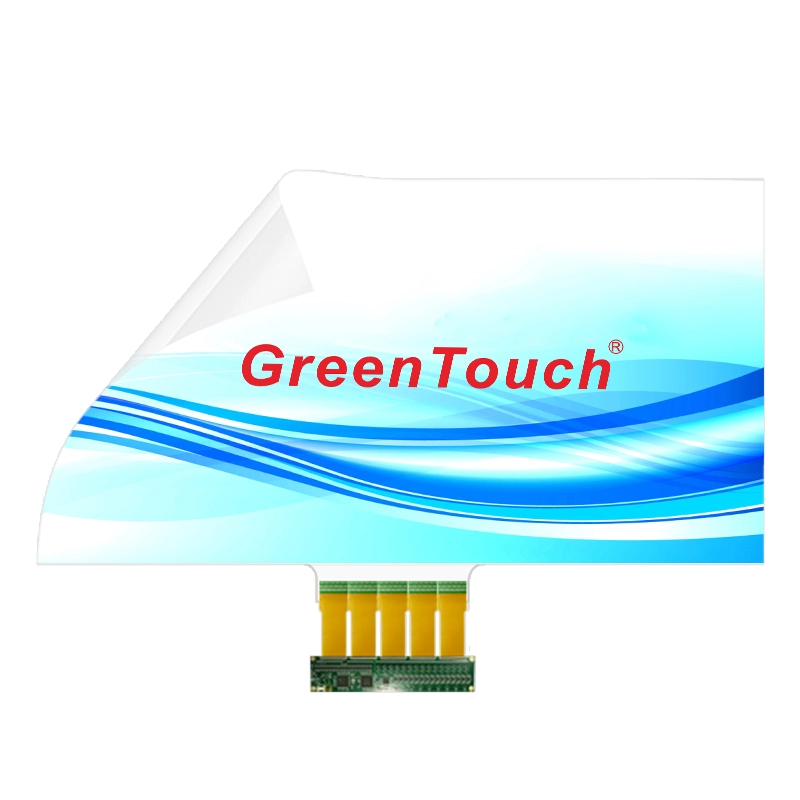
A touch foil takes a different approach. The sensing layer is extremely thin, so it can be attached to the rear of a transparent medium without significantly changing the appearance of the front surface. For curved installations, this flexibility makes it easier to maintain the original shape of the display while adding interactive functionality.
The XTC Series uses a film-to-film capacitive structure with a metal-wire grid arranged along X and Y axes. When a user touches the surface, the system detects changes in the electrical field and calculates the touch position.
The sensing film uses transparent PET material with a thickness of only 0.2 mm. This thin structure is important for applications where transparency and appearance are priorities.
The film provides a light-transmission rate of at least 93%, allowing the display underneath to maintain strong visual clarity. It also supports 40-point capacitive touch, making it suitable for interfaces involving multiple fingers, gestures, and simultaneous interaction.
For a curved display, the ability to conform to the surface is particularly useful. Rather than building a new rigid touch panel around every display shape, integrators can work with a flexible sensing layer and the existing transparent substrate.
Large interactive displays often create another engineering challenge: the larger the screen, the more difficult it can be to maintain a clean and seamless appearance.
The Interactive Touch Foil 43 to 180 Inches (XTC Series) is available in a broad range of sizes, including 43", 55", 65", 70", 75", 86", 98", 120", 150", and 180". The standard 16:9 format covers many commonly used commercial display dimensions.
Because the foil is integrated behind the transparent surface, there is no need to place a conventional touch frame around the visible edge. This borderless approach is useful when the visual design of the installation is as important as the interactive function.
For example, a large curved digital wall in a showroom can retain a continuous visual surface instead of appearing like a standard monitor with a thick external frame. The same principle can be applied to exhibition displays, interactive advertising systems, and public information installations.
A touch solution for public environments needs to handle more than basic touch recognition. It must also cope with frequent use, contamination, and accidental contact.
The XTC Series is designed with IP67 waterproof protection, vandal resistance, and anti-pollution performance. These characteristics can be valuable in public-facing installations where users may touch the screen repeatedly throughout the day.
The operating temperature range is specified from -10°C to 50°C, while storage conditions extend from -20°C to 60°C. The system supports up to 24/7 continuous operation, making it suitable for installations that need to remain active for long periods.
The touch deviation is specified at no more than 0.5 mm, while scanning speed reaches 8 ms per frame. These specifications help support responsive interaction for applications such as digital wayfinding, product selection, interactive presentations, and multimedia content navigation.
A technically capable touch film still needs to be straightforward for system integrators to install. The XTC Series uses a USB interface and is compatible with Windows, Android, and Linux systems.
The controller connects to the touch foil through its flexible printed circuit, while the controller can then connect to a computer or main control device through USB. The package includes the touch foil, controller, and USB cable.
Installation starts with preparing the rear surface of the glass, acrylic, or polycarbonate material. The surface needs to be clean, dry, and free of contaminants. The sensing side of the film is then aligned and carefully adhered to the substrate. During installation, air bubbles should be removed with a scraper to achieve a smooth result.
Once the foil is installed, the FPC is connected to the controller, followed by the USB connection to the host computer. Calibration can then be completed through the operating system's touchscreen settings.
This relatively direct process allows manufacturers and integrators to add touch functionality without redesigning the entire display structure.
Not every interactive display project uses the same dimensions or surface requirements. This is why customization can be important for commercial display manufacturers and system integrators.
The XTC Series supports customized sizes, logos, and installation services. Additional options include AG, AF, and AR treatments, depending on the requirements of the project.
Anti-glare treatment can be useful for environments with strong ambient lighting, while anti-fingerprint treatment can help maintain a cleaner appearance during frequent interaction. Anti-reflective treatment may also be considered where display visibility is a major concern.
These options allow the touch film to be adapted to different display designs instead of forcing the project to follow a fixed touchscreen structure.
For large-format touch applications, product specifications are only one part of the purchasing decision. Production capability, quality control, engineering support, and customization capacity can directly affect the final installation.
ShenZhen GreenTouch Technology Co.,Ltd. specializes in touch products and interactive display solutions, including capacitive touch screens, nano touch foil, infrared touch frames, touch monitors, touch all-in-one PCs, and digital signage.
The company operates a fully enclosed dust-free workshop and an automated production line. Its quality management system has received ISO9001 and ISO14001 certification, while its products have obtained certifications including CE, FCC, CB, RoHS, UL, and CCC.
GreenTouch also maintains dedicated R&D capabilities, with more than 20 technical engineers, more than 50 new products developed annually, and more than 10 annual patents. Its production facilities include a Class 1000 dust-free lamination workshop and support G+G, G+FF, and TP+LCM full-lamination technologies.
For customers developing customized large interactive displays, these capabilities can be important when moving from a single prototype to repeat production.
Curved touch foil is particularly useful when the display shape is part of the user experience. Potential applications include interactive retail displays, museum and exhibition installations, digital advertising systems, corporate experience centers, public information terminals, interactive education systems, and specialized control interfaces.
The key advantage is flexibility. Instead of treating the display and touch system as two separate rigid components, a transparent touch film can be integrated into the existing surface.
For projects that require a large interactive area, curved compatibility, high transparency, multi-touch operation, and customized installation, Interactive Touch Foil 43 to 180 Inches (XTC Series) offers a practical way to turn large glass, acrylic, or polycarbonate surfaces into interactive interfaces.
As display designs continue to move beyond traditional flat screens, flexible touch technology can give system designers more freedom without sacrificing touch accuracy, transparency, or installation efficiency.