RU
 ZH
 IT
 ES
 TR
 JA
 PT
 KO
 FR
 DE
 AR
 ID
Basic Product Setup
Learn More



Large interactive displays are no longer limited to conventional touchscreen monitors. In retail environments, exhibition spaces, educational facilities, and public information areas, designers increasingly want to turn existing glass or transparent panels into interactive surfaces. This approach offers greater flexibility in display size and appearance, but it also introduces practical engineering questions: How can touch functionality be integrated without adding a bulky frame? How can the original transparency of the display surface be maintained? And what should be considered when applying a touch-sensitive layer to a large glass or acrylic panel?
One solution is to use an ultra-thin capacitive touch film. With a transparent PET structure and a flexible sensing layer, Interactive Touch Foil 42 to 153 Inches (XTB Series) is designed to add interactive functionality to large display surfaces while keeping the overall structure relatively unobtrusive. Its 0.2 mm film thickness, support for multiple transparent substrates, and 40-point PCAP touch capability make it suitable for projects that require a combination of visual clarity and interactive input.
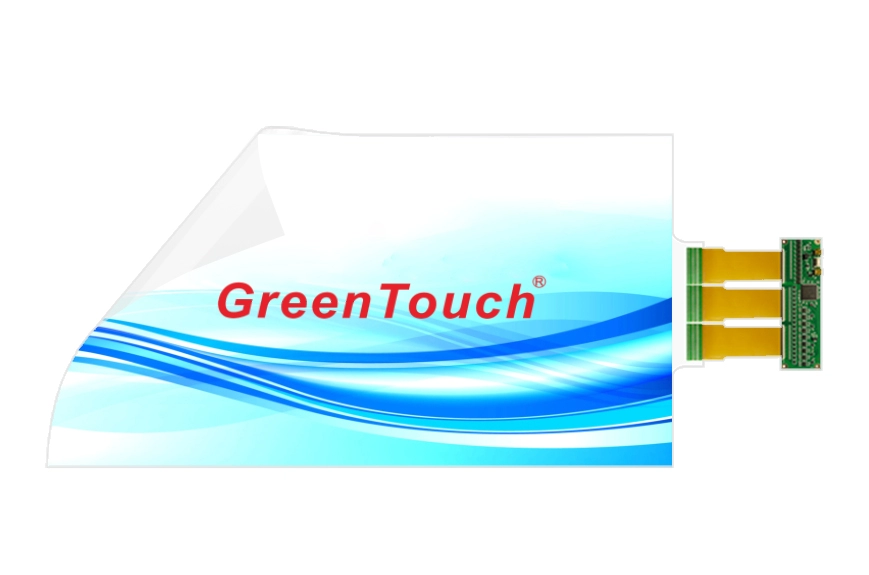
In a large-format interactive display, the touch component needs to work with the display structure rather than simply sit on top of it. A conventional touch panel may require a dedicated frame or a more substantial panel assembly. For projects using custom glass structures, transparent partitions, or non-standard display surfaces, these additional structural requirements can affect the final appearance and installation design.
A 0.2 mm transparent PET film provides a much thinner integration layer. Instead of relying on a thick touch panel, the film can be applied to the back of a compatible glass or acrylic surface. This allows the original transparent material to remain an important part of the display design while adding touch-sensing functionality.
The thin-film structure is particularly relevant when the display has a customized shape or needs to fit into an existing fixture. It can help reduce the physical presence of the touch component and support a more integrated, borderless appearance.
However, thinness alone does not determine whether a touch solution is suitable. The substrate, installation surface, sensing structure, controller, and display configuration all need to be considered together.
The XTB series uses a projected capacitive touch structure. According to the product design, the touch foil consists of two transparent thin films with a grid matrix formed by conductive metal wires arranged along the X and Y axes.
When a user touches the surface, the sensing system detects the change in capacitance at the corresponding position. The controller processes the signal and identifies the touch location, allowing the display system to respond to user input.
This grid-based structure makes it possible to provide accurate touch positioning across a large active area. The XTB series supports up to 40 touch points, which can be useful in applications involving simultaneous input, collaborative interaction, or multiple users working around a shared display.
For example, an interactive presentation table may allow several participants to select information or manipulate visual content at the same time. In a public information display, visitors can interact with different sections of an interface without relying on physical buttons.
The sensing film is only one part of the complete solution. The matching controller and the connection between the controller and the host system are also essential to reliable operation.
When a touch film is installed behind glass or acrylic, optical performance becomes an important consideration. The additional layer should not unnecessarily interfere with the content displayed through the transparent surface.
The XTB series specifies light transmittance of at least 93%. This high-transmittance design helps preserve display visibility while introducing touch functionality. For commercial displays, exhibition installations, and interactive glass applications, maintaining a clear viewing experience is important because users need to see both the displayed content and the touch interface.
The product also features an anti-glare design intended to support visibility from different viewing angles. Depending on the project environment, customers can further consider customized AG, AF, and AR treatments:
AG (Anti-Glare) helps reduce distracting reflections caused by ambient lighting.
AF (Anti-Fingerprint) is intended to reduce visible fingerprint marks on the treated surface.
AR (Anti-Reflection) helps manage reflections that may affect the viewing experience.
These treatments serve different purposes and should not be treated as interchangeable. The appropriate configuration depends on the lighting conditions, expected user contact, substrate, and display requirements.
For projects where visual quality is a major consideration, it is advisable to confirm the complete optical configuration with the supplier before finalizing the display structure.
A touch film does not operate independently of the surface to which it is applied. Substrate selection affects the installation process and the overall integration design.
The XTB series is applicable to glass, acrylic, and polycarbonate. These materials are commonly considered in transparent display structures, but they have different physical characteristics and project requirements.
Glass is often selected for commercial display surfaces and architectural installations where a rigid, transparent panel is required. Acrylic can be useful in projects that need a lightweight transparent material or a customized panel shape. Polycarbonate may be considered where the project requires a different balance of impact resistance, weight, and fabrication flexibility.
Before installation, the selected surface should be clean, flat, and dry. The sensing side of the film must be aligned correctly with the back of the substrate. Air bubbles, dust, wrinkles, or poor adhesion can affect the finished appearance and may interfere with the intended installation quality.
For this reason, substrate compatibility should be confirmed during the design stage rather than left until the equipment is ready for assembly.
A consistent installation process helps reduce avoidable problems when integrating a large-area touch film. The XTB series follows a practical sequence that covers surface preparation, film adhesion, controller connection, and system calibration.
First, clean the back of the glass or acrylic panel and make sure the surface is completely dry. Dust and other contaminants should be removed before the protective layer is peeled away.
Next, align the sensing side of the film with the designated installation area. Apply the film carefully and use a scraper to remove trapped air bubbles. The film should be smooth and wrinkle-free after adhesion.
The flexible printed circuit (FPC) at the end of the film is then connected to the matching touch controller through the appropriate connector. After that, connect the controller to the computer or main control device using the supplied USB cable.
The final stage is system setup and calibration. Although the product information describes USB connectivity as driver-free in normal use, the installation instructions also refer to driver installation and touchscreen calibration. The actual procedure may depend on the operating system and controller configuration, so the project team should follow the supplier's instructions for the specific setup.
A careful installation process is especially important for large formats. As the active area increases, alignment and surface preparation become more demanding. Planning the installation method before the substrate is manufactured can help avoid rework.
The touch controller connects to the host device through a USB 2.0 full-speed interface. The product specification lists a transmission speed of up to 480 Mbps and compatibility with Windows, Android, and Linux systems.
This connection method helps simplify integration with a range of commercial display and interactive equipment. The supplied packing list includes one touch foil, one controller, and one USB cable, providing the main components required for the touch connection.
During system planning, buyers should still check the host device's available USB ports, operating system version, controller requirements, and the physical routing of the FPC cable. For large display installations, cable access and controller placement should be considered alongside the mechanical design.
The XTB Series capacitive touch foil is available in a range of standard sizes, from 42 inches to 153 inches. Listed options include 42, 43, 48, 49, 50, 55, 60, 65, 70, 75, 84, 86, 98, 100, 110, and 153 inches. This range gives project developers more flexibility when matching the touch area to the display dimensions.
The combination of a thin PET structure, transparent optical performance, and large-format touch capability makes this type of solution relevant to several project categories.
In retail environments, touch foil can be integrated with glass display surfaces to create interactive product information points or promotional interfaces. In exhibition spaces and museums, large transparent panels can become interactive information surfaces without requiring a conventional framed touchscreen.
Educational and collaborative environments may use large interactive surfaces for presentations, shared content, and group participation. Public spaces can also incorporate touch-enabled glass or acrylic panels into information systems, provided that the complete installation is designed for the expected operating environment.
The XTB series specifies IP67 waterproof protection and features intended to resist vandalism, contamination, and surface wear. These characteristics can be relevant when evaluating touch interfaces for demanding environments. However, the protection level of a completed installation also depends on the enclosure, cable openings, controller placement, and installation details. The rating of the touch foil should not automatically be interpreted as the rating of the entire display assembly.
Large interactive display projects often involve requirements that go beyond selecting a standard size. The XTB series supports customization of dimensions, logos, pasting services, and AG, AF, and AR surface treatments. These options allow the touch film configuration to be considered alongside the project's display design and installation process.
For buyers, it is useful to prepare several details before requesting a quotation or technical evaluation: the required active touch area, substrate material, whether the surface is flat or curved, the operating system, expected user interaction, and the environmental conditions. Providing these details early can help the manufacturer assess the appropriate configuration and installation method.
ShenZhen GreenTouch Technology Co.,Ltd. is a professional manufacturer of touch products, with a product portfolio covering capacitive and resistive touch screens, infrared touch frames, nano touch foil, touch monitors, touch all-in-one PCs, and digital signage equipment.
The company operates a fully automatic production line and an enclosed dust-free workshop, supported by ISO 9001 quality management system and ISO 14001 environmental management system certifications. Its technical resources include more than 20 engineers and a research and development program that introduces over 50 new products annually. The company also reports more than 20 patent certificates and over 60 other certificates.
Its manufacturing capabilities include Class 1000 dust-free lamination, G+G and G+FF bonding, and TP+LCM full lamination processes. With a 5,000 m² standard production workshop and warehouse facilities in Huizhou and Shenzhen, GreenTouch supports the production and storage needs of different touch product projects.
For customers developing large interactive display systems, working with a manufacturer that understands both touch sensing and display integration can make it easier to coordinate material selection, customization, controller configuration, and production requirements.
A successful large-format touch display depends on more than the touch technology itself. Film thickness, sensing structure, substrate compatibility, optical performance, installation quality, and controller connectivity all influence the final result.
The 0.2 mm PET structure of Interactive Touch Foil 42 to 153 Inches (XTB Series) provides a thin integration layer for glass, acrylic, and polycarbonate surfaces. Combined with up to 40-point PCAP touch, at least 93% light transmittance, USB connectivity, and customizable options, it offers a practical approach to creating large interactive surfaces.
For projects involving non-standard dimensions, transparent panels, or curved display structures, the key is to evaluate the touch film as part of the complete display assembly. By confirming the substrate, installation conditions, and system requirements early, project teams can make more informed decisions and reduce integration issues during production.
To discuss large-format touch integration, substrate compatibility, or customization requirements, contact ShenZhen GreenTouch Technology Co.,Ltd. and explore the Interactive Touch Foil 42 to 153 Inches (XTB Series) for your next display project.