 RU
RU ZH
ZH IT
IT ES
ES TR
TR JA
JA PT
PT KO
KO FR
FR DE
DE AR
AR ID
ID
Why Curved Touch Foil Matters for Non-Flat Interactive Displays
Learn More



Digital signage content does not always fit the same screen orientation. A restaurant menu may work better in portrait mode, while a promotional video or product presentation may need a wider landscape layout. When a display is installed in a busy commercial environment, changing its orientation should not require a complicated setup every time the content format changes.
This is where gravity sensing can make a digital signage system more flexible. The Ultra-thin Digital Signage 32-65 Inches (7A-G Series) supports gravity sensing and free switching between portrait and landscape orientations, giving businesses more flexibility when displaying different types of content. Instead of treating screen orientation as a fixed installation decision, the display can adapt to the way information needs to be presented.
Portrait and landscape displays serve different content formats.
Portrait orientation naturally suits vertically arranged information such as menus, posters, promotional offers, membership campaigns, product lists, and retail advertisements. A vertical layout can also make better use of narrow wall areas, especially near entrances, elevators, checkout counters, and store windows.
Landscape orientation provides more horizontal space for videos, product demonstrations, panoramic graphics, presentations, and content designed around conventional widescreen formats.
The challenge comes when a business needs both types of content. A display that is permanently installed in one orientation may require content to be redesigned or manually adjusted whenever the marketing plan changes.
The 7A-G Series addresses this issue with gravity sensing. The display can detect its orientation and support switching between portrait and landscape modes. This allows the same digital signage platform to accommodate different content layouts without limiting the installation to a single viewing format.
Gravity sensing is particularly useful when the screen needs to change orientation according to the application.
For example, a restaurant can use portrait mode for vertically structured menus and promotional offers. If the same display is later used to show a product video or a wider promotional campaign, landscape orientation may be more suitable.
In a retail store, portrait mode can be used for product posters, membership promotions, or limited-time offers. Landscape mode can then be used for product demonstrations, brand videos, or wider promotional graphics.
The practical value is that the hardware does not need to be treated as a single-purpose advertising screen. Its orientation can support different content strategies.
The 7A-G digital signage is designed around this flexibility, combining gravity sensing with an information publishing system, remote program publishing, split-screen playback, and multi-format content playback.
Many offline marketing locations do not have unlimited wall space. A display may need to fit beside a doorway, inside a storefront, near an elevator, along a supermarket aisle, or next to a cashier.
Portrait orientation can be useful in these locations because the display occupies a relatively narrow section of wall while providing a tall visual area.
The 7A-G Series is available in 32-inch, 43-inch, 50-inch, and 65-inch configurations. This range gives project planners options for different installation areas.
A smaller display can be suitable where wall width is limited, while a larger screen can provide more room for product images, promotional graphics, and detailed information.
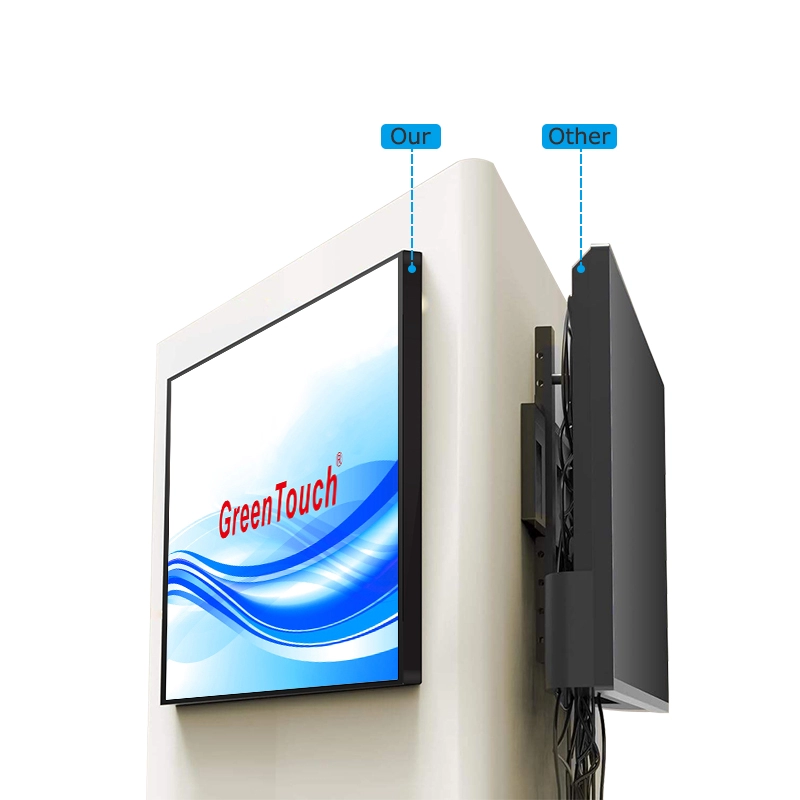
Because the 7A-G is only 28 mm thick, it can also be mounted close to the wall with a zero-distance wall-mounted design. This is particularly relevant for commercial locations where the display needs to remain visually integrated with the surrounding interior rather than projecting significantly from the wall.
Landscape orientation remains useful for content created around traditional widescreen formats.
Promotional videos, product demonstrations, event videos, brand presentations, and wide-format graphics can benefit from additional horizontal viewing space. When content is originally produced for a landscape layout, forcing it into a portrait format can result in unused space, cropping, or a less effective composition.
The 7A-G Series supports UHD 4K or Full HD 1920 × 1080 resolution depending on configuration. This gives businesses flexibility when selecting the display configuration according to content requirements.
The display also features a 1.07-billion color depth and 90% NTSC color gamut. These specifications help support detailed visual content, particularly when the signage is being used for product imagery, brand graphics, or promotional video.
Gravity sensing becomes more useful when combined with flexible content publishing.
The 7A-G Series supports remote program publishing and an information publishing system. Content can be managed for different locations, while split-screen playback and multi-format combination playback allow several types of information to be presented on the same screen.
For a chain store, one display could show a vertical membership promotion in portrait mode during one campaign and switch to landscape promotional video content during another. For a restaurant, the display could present a portrait-oriented menu during service hours and use a landscape promotional video during another period.
Time-segmented playback can also be configured to match different operating periods. Timed power-on and power-off functions provide additional control over the display's daily operating schedule.
These functions are more practical when they are considered together. Orientation determines how the content is presented, while publishing and playback functions determine when and how that content appears.
Changing between portrait and landscape orientations is more useful when the physical design of the display does not create unnecessary installation constraints.
The 7A-G Series uses a 28 mm ultra-thin body with a tempered glass panel and black metal shell. Its thin-bezel design and 178° ultra-wide viewing angle are intended for commercial environments where viewers may approach the display from different positions.
The slim profile is particularly relevant to wall-mounted installations. A display placed in an elevator lobby, storefront, supermarket aisle, or cashier area can remain close to the wall rather than taking up additional space.
This also supports a cleaner visual presentation. Instead of making the display itself a dominant physical object, the installation can focus attention on the content shown on the screen.
The most useful way to decide between portrait and landscape is to start with the content and location rather than the screen size alone.
For storefronts, portrait mode can be effective for vertically structured advertisements, product posters, and membership campaigns. The tall format can attract attention from people approaching the store.
In supermarket aisles, portrait orientation can help display product promotions in a relatively narrow space. The display can present several pieces of vertically arranged information without requiring a wide wall area.
For restaurant front halls, portrait mode can work well for menus, seasonal promotions, and ordering-related information. Landscape mode can become more suitable when the display is used for food videos or brand presentations.
In elevator lobbies, the combination of a slim body and wall-mounted installation is useful where available space is restricted. Content can be arranged vertically for announcements and promotional messages.
At cashier areas, businesses may combine product information, membership campaigns, promotional messages, and service notices. Depending on the content layout, either portrait or landscape presentation can be used.
The display supports Android 11, 12, 13, and 14 configurations, providing a software platform for digital signage applications and content publishing.
This is important because orientation is not only a physical consideration. The software and content system also needs to handle different display layouts correctly. Applications designed for portrait content need to render properly in vertical mode, while landscape-oriented applications need to use the available horizontal space effectively.
The 7A-G platform can therefore be considered as a combination of physical display design and software flexibility rather than simply a screen with two mounting options.
ShenZhen GreenTouch Technology Co.,Ltd. develops and manufactures touch and display products, including touch screen monitors, advertising digital signage, touch all-in-one PCs, capacitive touch screens, resistive touch screens, infrared touch frames, and nano touch foil.
The company operates a Class 1000 dust-free lamination workshop and supports G+G, G+FF bonding, and TP+LCM full lamination technologies. Its R&D team includes more than 20 technical engineers, with more than 50 new products developed annually and more than 10 annual patents according to the company's provided information.
For digital signage projects, manufacturing capability matters because the display may be deployed across multiple commercial locations with consistent requirements for structure, display performance, and content operation.
Portrait and landscape modes should not be viewed simply as two installation choices. They are ways of matching the physical screen to the information being presented.
A vertical menu, promotional poster, or product list can benefit from portrait orientation, while a promotional video, product demonstration, or wide-format presentation may work better in landscape mode. Gravity sensing makes this transition more practical by allowing the 7A-G Series to support free switching between the two orientations.
Combined with its 28 mm ultra-thin structure, zero-distance wall mounting, thin bezel, 178° viewing angle, Android 11–14 support, remote publishing, split-screen playback, and scheduled content functions, the Ultra-thin Digital Signage 32-65 Inches (7A-G Series) provides a flexible platform for commercial advertising and information display.
For businesses managing different content formats across storefronts, supermarkets, restaurants, elevator lobbies, and cashier areas, 7A-G Digital Signage offers a practical way to make screen orientation part of the content strategy rather than a permanent limitation.