 RU
RU ZH
ZH IT
IT ES
ES TR
TR JA
JA PT
PT KO
KO FR
FR DE
DE AR
AR ID
ID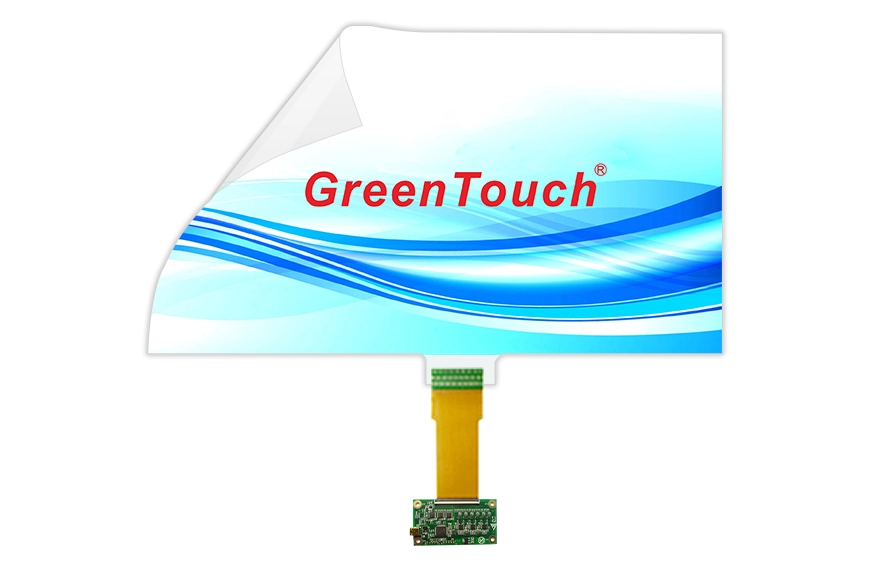
12-Point PCAP Touch Foil: Matching Touch Accuracy to Interactive Applications
Learn More



In 2026, industrial capacitive touch monitors are evolving beyond conventional display and control terminals. As smart manufacturing, industrial automation, edge computing, and artificial intelligence continue to move onto the factory floor, industrial touch displays are becoming an important HMI interface connecting operators, machines, and real-time production data.
According to the 2026 NIST Roadmap on Artificial Intelligence and Machine Learning for Smart Manufacturing, AI and machine learning are advancing applications such as industrial big-data analytics, advanced sensing, autonomous systems, robotics, digital twins, and intelligent manufacturing. These developments are increasing demand for more capable and reliable human-machine interfaces at the equipment level.
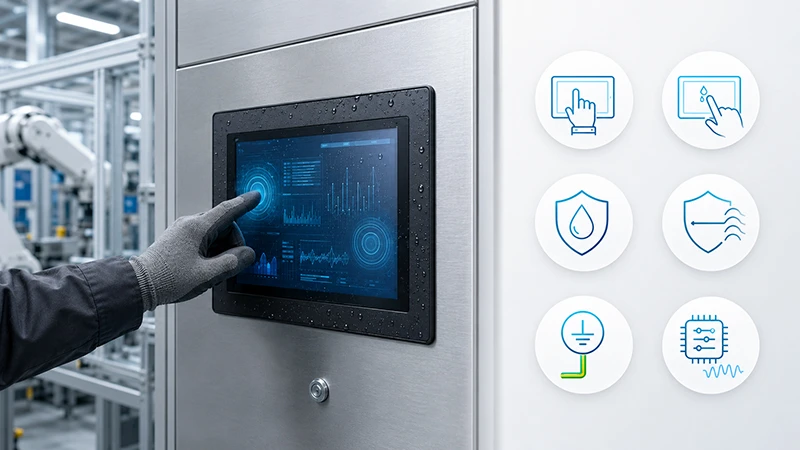
Projected capacitive touch technology (PCAP) remains an important choice for modern industrial HMIs because it supports responsive operation, multi-touch interaction, and intuitive gestures. Mitsubishi Electric's GOT3000 HMI, launched globally in May 2026, for example, combines a high-definition display with capacitive multi-touch operation, including familiar swipe, pinch, and tap gestures.
At the same time, industrial users are paying greater attention to touch reliability under real operating conditions. Glove operation, wet-touch performance, water rejection, EMI resistance, grounding, cover-glass thickness, power-supply noise, and firmware tuning can all affect PCAP performance. This means an industrial capacitive touch monitor must be evaluated as a complete system rather than only by its touchscreen specification.
Another major trend in 2026 is the convergence of industrial HMI and Edge AI. New modular HMI platforms are bringing GPU-supported AI processing directly to the factory floor, enabling applications such as machine vision, defect detection, error-proofing, real-time analytics, and intelligent equipment monitoring without relying entirely on cloud processing.
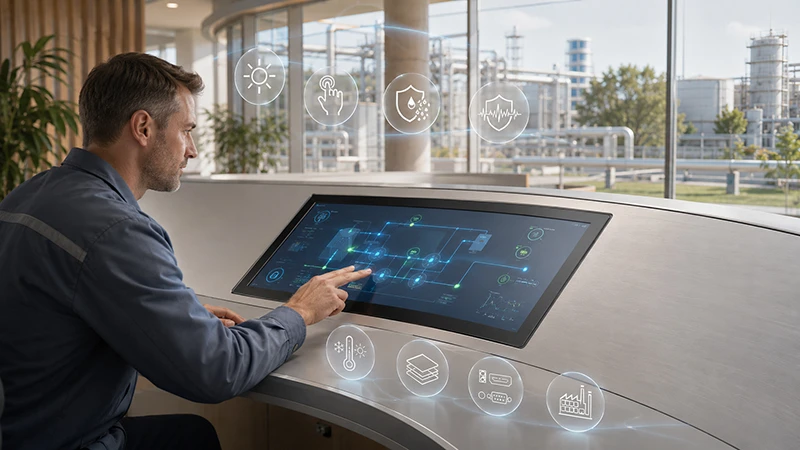
As a result, industrial touch displays are no longer defined simply by “display + touch.” Features such as PCAP multi-touch, rugged construction, IP-rated protection, anti-glare treatment, optical bonding, EMI resistance, wide-temperature operation, flexible I/O, and long-term availability are becoming increasingly important for OEMs, machine builders, and system integrators.
Looking ahead, industrial capacitive touch monitors will continue to play a central role in factory automation, industrial control, machine vision, logistics, energy systems, intelligent equipment, and AI-enabled manufacturing, providing a reliable interface between people and increasingly intelligent machines.