 RU
RU ZH
ZH IT
IT ES
ES TR
TR JA
JA PT
PT KO
KO FR
FR DE
DE AR
AR ID
ID
32-65 Inch Ultra-Thin Digital Signage: Applications and Buying Guide
Learn More



With the rapid development of Large Language Models (LLMs) and AI Agent technologies, traditional touchscreen human-machine interaction is entering a new stage of evolution. Future industrial touchscreens will no longer function only as display and input devices, but will become intelligent interaction terminals capable of understanding user intentions, analyzing equipment conditions, and providing proactive solutions.
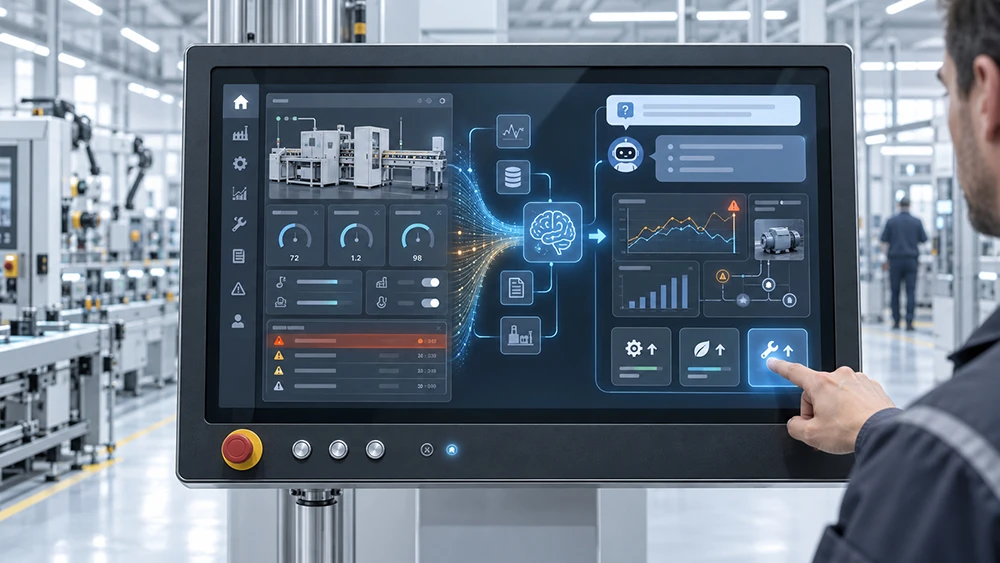
Traditional HMI (Human Machine Interface) systems rely mainly on fixed menus, buttons, and parameter pages for equipment operation. Operators often need to navigate through multiple screens to find information, check machine parameters, and analyze alarm records. With the integration of AI Agents powered by large language models, users can communicate with touchscreens through natural language. For example, an operator can ask, “Why is the machine generating this alarm?” or “How can production efficiency be improved?” The AI system can analyze equipment data, historical records, and operating conditions to provide intelligent recommendations.
In industrial automation, AI Agents enhance the capability of touchscreens to understand and process complex data. By connecting with industrial sensors, PLC systems, MES platforms, and digital twin technologies, AI-powered touch displays can monitor production status in real time, support predictive maintenance, and provide intelligent operation guidance. This transformation changes HMI from a passive control interface into an active assistant for operators.
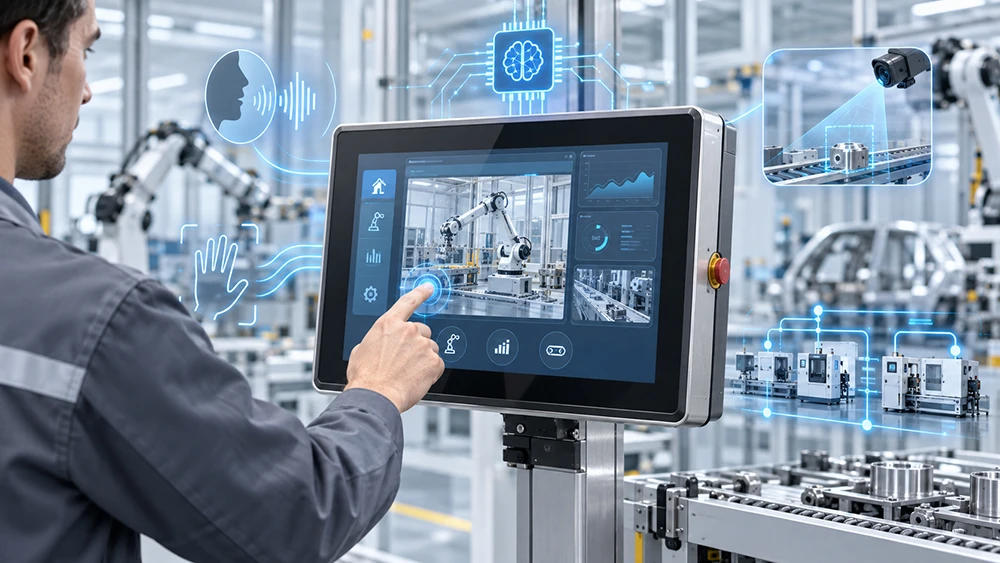
In the future, AI Agents will continue to integrate with voice recognition, computer vision, gesture interaction, and edge computing technologies to create multimodal intelligent HMI systems. Users will be able to manage equipment not only through touch input but also through voice and visual interaction, making the touchscreen a key gateway connecting humans, machines, data, and artificial intelligence.
Large Language Model AI Agents are driving the evolution of touchscreens from traditional input-output devices into cognitive human-machine interaction platforms. For smart manufacturing, industrial automation, self-service terminals, smart retail, and medical equipment, AI-powered touchscreens will become an important direction for the next generation of digital interaction.