RU
 ZH
 IT
 ES
 TR
 JA
 PT
 KO
 FR
 DE
 AR
 ID

The Importance of CE Certification for Industrial Touch Screens
Learn More



Large touch displays are often evaluated by resolution first, but resolution alone does not determine whether an image looks natural, detailed, and easy to interpret. A 65-inch screen can provide 4K resolution and still produce limited visual results if its color reproduction and image processing are not well matched to the display size. For professional interactive applications, HDR, color depth, and color gamut can have a direct effect on how clearly users distinguish visual information.
The 65 Inch 4K UHD Touch Screen Monitor combines 3840 × 2160 UHD resolution with 1.07 billion display colors, HDR, 99% sRGB coverage, and 95% DCI-P3 coverage. These specifications work together rather than functioning as isolated features. When the display is used for interactive presentations, control interfaces, professional visualization, education, commercial displays, or other large-screen applications, the combination can provide more distinct transitions between colors, better highlight and shadow detail, and a more natural overall image.
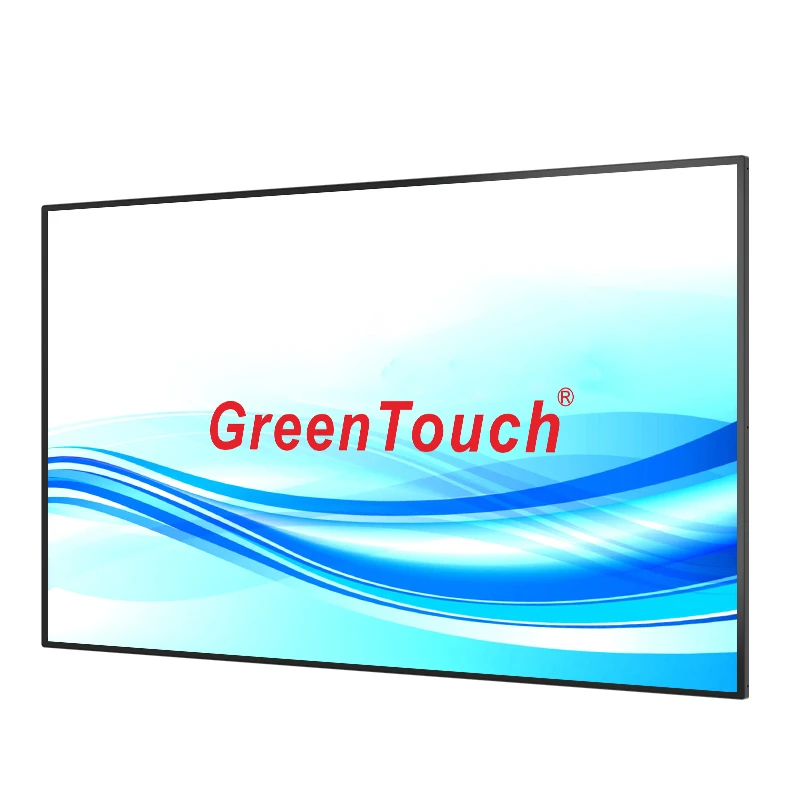
High Dynamic Range, or HDR, is mainly concerned with the range of brightness and contrast represented in an image. On a large display, this can be particularly useful because viewers are more likely to notice differences between bright highlights, midtones, and darker areas.
Without sufficient dynamic range, bright areas may appear washed out while darker portions can lose visible detail. HDR is designed to preserve more information across these areas. For example, a technical visualization containing both illuminated components and darker structural sections can benefit from clearer separation between the two.
The HDR capability of the 65 Inch 4K UHD Touch Screen Monitor is therefore not simply an additional display specification. It supports a more differentiated image, particularly when content contains strong changes in brightness. This is useful in environments where users need to inspect visual information rather than simply watch general video content.
For interactive applications, image clarity also matters when the user is touching the screen, moving objects, reading diagrams, or comparing visual elements. A clearer image can make the relationship between the interface and the displayed content easier to understand.
Color depth determines how many individual color values a display can reproduce. The monitor uses 1.07 billion display colors, providing substantially more color gradations than displays with a more limited color range.
The practical benefit is smoother color transitions. When a display has insufficient color gradation, subtle changes may appear as visible steps instead of a continuous transition. This effect is commonly referred to as color banding. It can be noticeable in gradients, photographs, digital graphics, maps, rendered scenes, and other visual content.
With 1.07 billion colors, the 65 Inch 4K UHD Touch Screen Monitor can represent finer differences between adjacent shades. This does not mean that every application will visibly use all available color values, but it gives the display greater capability when the source content contains detailed gradients or complex color information.
This is especially relevant on a 65-inch screen. As the physical display area increases, visual imperfections can become easier to notice. A large screen therefore benefits from more precise color reproduction, particularly when viewed at close range in interactive environments.
Color depth and color gamut address different aspects of display performance. A high color depth allows smoother transitions between colors, while a wider color gamut allows the display to reproduce a broader range of colors.
The monitor provides 99% sRGB and 95% DCI-P3 coverage. These two color spaces are commonly used in different types of digital content, so supporting both provides flexibility for various workflows.
For standard digital content, high sRGB coverage helps maintain consistent color reproduction. DCI-P3 coverage is useful when working with content that requires a broader color range. The 95% DCI-P3 specification gives the display a strong capability for reproducing colors beyond the traditional sRGB range.
For system integrators, this distinction is important. A display should be selected according to the content and application requirements rather than based on one specification alone. If the project involves digital graphics, video, visualization, or content where color differences are important, checking both gamut and color depth can provide a more useful assessment of the display.
The visual effect of HDR and color depth becomes more meaningful when combined with high resolution. The monitor uses 3840 × 2160 UHD resolution, providing four times the pixel count of a 1920 × 1080 Full HD display.
Higher pixel density helps define fine image details, but detailed pixels still need appropriate color information to produce a convincing image. A high-resolution display with limited color reproduction may show sharp edges without delivering smooth gradients or accurate tonal transitions.
The 65 Inch 4K UHD Touch Screen Monitor combines UHD resolution with 1.07 billion colors, 99% sRGB, 95% DCI-P3, and HDR. This combination gives system designers several display characteristics to consider together instead of evaluating resolution in isolation.
For example, an interactive presentation may contain photographs, diagrams, charts, video clips, and colored interface elements on the same screen. Resolution supports fine detail, while color depth and gamut help distinguish the visual information. HDR can further improve the separation of bright and dark areas.
A large interactive display has another requirement that a conventional monitor does not: users need to interact directly with the image.
The monitor uses projected capacitive 10-point touch technology, allowing multiple touch points to be detected simultaneously. This can support collaborative interaction, gesture-based controls, annotation, and other touch operations.
The touch panel is optically bonded to the LCD panel, helping maintain a direct relationship between the displayed content and the touch surface. Combined with the thin-bezel structure and 178-degree ultra-wide viewing angle, the design is suitable for environments where several people may view or interact with the screen from different positions.
In these situations, image depth is not only a matter of visual quality. It can affect how easily users distinguish buttons, diagrams, colored indicators, photographs, and other interface elements during operation.
When selecting a 65-inch touch display, buyers should evaluate the complete display system instead of focusing on one specification.
First, confirm the source content and its required color space. A project centered on standard business content may have different requirements from one involving professional graphics or video.
Second, consider viewing distance and installation conditions. A large 65-inch screen may be viewed from different angles, making the 178-degree viewing angle useful for meeting rooms, teaching spaces, commercial environments, and other shared viewing scenarios.
Third, check the available input interfaces. This monitor provides HDMI 2.0, HDMI 1.4, DP 1.2, USB, and AUDIO connections. Having multiple video input options makes it easier to integrate computers, media sources, and other equipment into the display system.
Surface treatment can also be selected according to the application. AG is available as a standard treatment, while AR, AF, and antibacterial options can be considered for projects with different requirements related to reflection, fingerprints, or hygiene.
For continuous-use installations, service life is another practical consideration. The display is designed for 7×24 operation and has a stated service life of up to 50,000 hours under normal operating conditions. This is relevant for professional systems that are expected to remain active for extended periods.
GreenTouch approaches these requirements from both display engineering and touch-product manufacturing perspectives. The company operates a 5,000 m² standard production workshop and a Class 1000 dust-free lamination workshop, with G+G, G+FF, and TP+LCM full-lamination capabilities. Its production capacity exceeds 600 touch panels per day, while its R&D team includes more than 20 technical engineers.
The company's broader product range covers capacitive and resistive touch screens, infrared touch frames, nano touch foil, touch screen monitors, touch all-in-one PCs, digital signage, and other interactive display products. This product coverage allows display projects to be evaluated not only from the perspective of the panel itself but also from the perspective of touch integration and system application.
HDR and 1.07 billion colors are most useful when they are considered as part of a complete display configuration. HDR contributes to brightness and image separation, while higher color depth supports smoother tonal transitions. Color gamut determines the range of colors that can be reproduced, and 4K resolution provides the pixel density needed to display fine visual details.
For a large interactive screen, these specifications become even more relevant because users may view the display from different distances and angles while simultaneously interacting with the content.
The 65 Inch 4K UHD Touch Screen Monitor brings these elements together with 3840 × 2160 resolution, 1.07 billion colors, 99% sRGB, 95% DCI-P3, HDR, 10-point capacitive touch, and multiple display interfaces. For professional display projects, evaluating these specifications together provides a more realistic picture of the monitor's capabilities than looking at resolution alone.
As interactive displays continue to move into professional visualization, education, commercial presentation, and other demanding environments, image quality increasingly depends on the combination of resolution, dynamic range, color depth, and color gamut. For system integrators and OEM buyers, understanding how these specifications work together makes it easier to select a display that fits the actual content and operating conditions.
GreenTouch provides touch display products designed around these practical integration requirements, including the 65 Inch 4K UHD Touch Screen Monitor for large-format interactive applications.