
 RU
 ZH
 IT
 ES
 TR
 JA
 PT
 KO
 FR
 DE
 AR
 ID
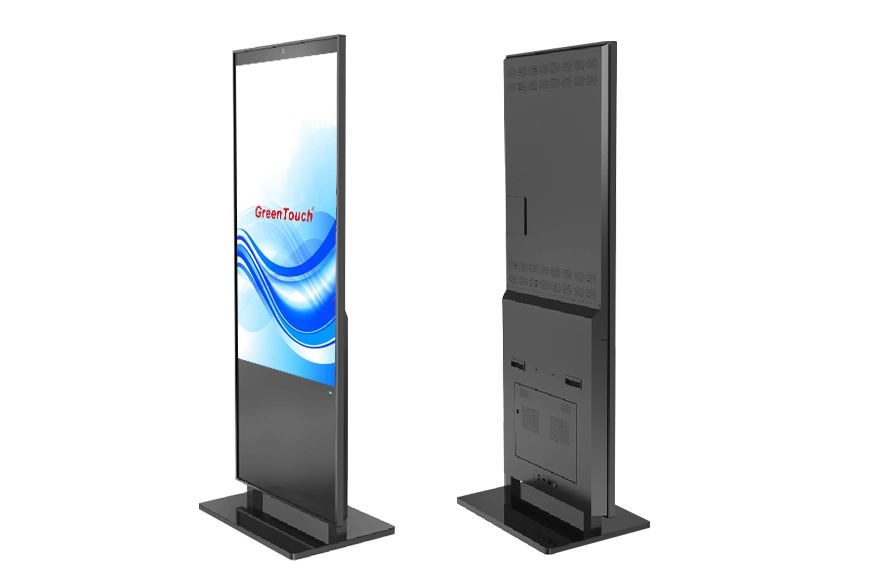
Aviation-Grade Aluminum Heat Dissipation for 24/7 Floor Standing Digital Signage
Learn More



Industrial touch monitors often operate in environments where dust, moisture, vibration, and long operating hours place additional demands on equipment design. In automated production lines, control cabinets, and public-facing terminals, a display may need to remain active throughout the day without frequent maintenance. Under these conditions, heat management becomes an important part of selecting an industrial monitor.
Cooling design is not simply a matter of adding a fan or increasing the size of the enclosure. The housing material, internal component arrangement, ventilation requirements, and installation environment all influence how heat is managed. A fanless monitor with an aluminum housing and a finned rear cover uses the enclosure itself as part of the thermal management structure.
The Panel Mount Touch Monitor 10.1-23.8 Inches (3D Series) from GreenTouch follows this design approach. It combines an aluminum alloy enclosure, a finned back cover, and a fully enclosed structure to support industrial display applications where durability, quiet operation, and reduced exposure to external contaminants are important.

A standard office monitor is generally used in a relatively clean indoor environment, with less demanding operating conditions. Industrial touch monitors, however, may be installed inside control cabinets, production equipment, transportation systems, or public facilities. These locations can expose displays to dust, moisture, temperature changes, and continuous operation.
Cooling fans can move air through an enclosure, but they also introduce additional mechanical components. In environments containing airborne dust or fine particles, a fan and its air openings may create additional maintenance concerns. Moving parts can also become another potential failure point over extended operating periods.
A fanless design removes the need for an internal cooling fan. This does not mean that heat disappears or that the monitor generates no thermal load. Instead, heat must be transferred through the internal structure and dissipated through the enclosure.
For industrial equipment designers, the main consideration is whether the monitor's passive thermal design is appropriate for the actual installation environment. Component power consumption, ambient temperature, cabinet airflow, mounting orientation, and available clearance around the rear housing should all be considered during system planning.
Aluminum is widely used in industrial equipment enclosures because it combines relatively low weight with useful mechanical and thermal properties. In a touch monitor, an aluminum housing can serve two purposes: protecting internal components and providing a path for heat transfer from the interior to the external surface.
The 3D series uses a seamless aluminum unibody design. Its bezel and back cover are manufactured using a customized aluminum alloy mold and a one-piece die-casting process. This construction provides a more integrated enclosure than a design assembled from multiple loosely connected housing sections.
From a thermal perspective, the rear housing is an important part of the heat dissipation path. Heat generated by internal electronic components can transfer through the internal mounting structure to the aluminum enclosure. The external housing then releases heat into the surrounding environment through natural convection and surface radiation.
The effectiveness of this process depends on more than the material alone. The contact between internal components and the housing, the available surface area, the enclosure geometry, and the surrounding air conditions all influence the final thermal performance.
This is why enclosure design should be evaluated as part of the complete monitor rather than by looking at aluminum material specifications in isolation.
A flat metal surface can dissipate heat, but a finned structure provides additional external surface area within a relatively compact footprint. The fins on a monitor's rear cover create more surface area that can exchange heat with the surrounding air.
As heat moves from the internal components into the rear housing, the fins help transfer that heat to the environment. Air surrounding the fins warms and moves upward through natural convection, allowing cooler air to replace it. This process supports passive heat dissipation without requiring a fan to force airflow.
For equipment designers, this structure can be useful when a monitor needs to operate without adding fan noise or creating dedicated air intake and exhaust openings.
However, finned covers still require suitable installation conditions. If the rear of the monitor is installed too close to another panel or enclosed in a confined space, airflow around the fins may be restricted. Dust accumulation can also reduce the effectiveness of the exposed surface over time.
When integrating a fanless monitor into a cabinet, engineers should therefore check the rear clearance, mounting orientation, surrounding equipment, and expected ambient temperature. The finned structure is part of the cooling solution, but it cannot compensate for every installation limitation.
Passive cooling is particularly relevant when a monitor also needs a sealed housing. Industrial displays may be exposed to dust, water splashes, dirt, and other contaminants that can affect electronic components if they enter the enclosure.
A fan-cooled monitor typically needs an airflow path. Depending on the design, this may involve openings, filters, or other components that require periodic inspection. A fully enclosed fanless monitor avoids the need for a conventional internal fan ventilation path.
The 3D series features a fully sealed housing and front-side IP65 protection. This design is intended to resist the entry of dust and water from the protected front side under the specified test conditions. It is relevant to equipment installed in production areas, public facilities, and other locations where the display surface may require regular cleaning or exposure to environmental contaminants.
It is important to distinguish front-side protection from the protection level of the entire installed system. The final result also depends on the cabinet opening, panel gasket, cable connections, and installation workmanship. Engineers should confirm the protection requirements of the complete assembly rather than assume that the monitor's front protection automatically applies to every side of the installation.
The combination of a sealed housing and fanless cooling can help simplify the enclosure design by reducing dependence on forced-air ventilation.
In industrial automation, a monitor may be used as an operator interface throughout multiple shifts. Production information, equipment status, alarms, and process controls need to remain visible during normal operation.
Removing the cooling fan eliminates fan noise and avoids maintenance associated with a moving cooling component. It also removes one potential source of dust movement inside the enclosure. These characteristics can be useful in manufacturing environments, laboratory equipment, and public-facing installations where quiet operation and reduced routine maintenance are preferred.
The 3D series is designed for stable industrial operation and supports projected capacitive 10-point touch. Its touch panel is optically bonded to the LCD panel, creating an integrated display assembly for accurate touch input and visual presentation.
The 3D Series industrial touch monitor is available in sizes from 10.1 inches to 23.8 inches, allowing equipment manufacturers to select a display format that fits the available control panel space. Its applications include industrial automation, smart manufacturing, medical and laboratory equipment, transportation, retail, food service, energy, and utilities.
Continuous operation still requires proper system-level thermal planning. The monitor's operating temperature range, internal power requirements, and installation conditions should be checked against the actual project environment. A fanless design is not a substitute for verifying these operating limits.
Thermal management is only one part of industrial monitor engineering. The display structure also needs to provide clear visual output and reliable touch response.
The 3D series uses optical bonding between the touch panel and LCD panel. By bonding these layers together, the assembly reduces the air gap that would otherwise exist between the two components. This construction can help reduce internal reflections and improve the visual integration of the touch and display layers.
The monitor supports 10-point projected capacitive touch, enabling users to interact with the interface through multiple simultaneous touch points. This is useful for control interfaces that involve gestures, multi-finger operations, or interactive navigation.
The aluminum bezel and rear cover provide the mechanical enclosure, while the bonded touch and LCD assembly forms the front display structure. These components need to be considered together when designing a panel-mounted industrial terminal.
Optional surface treatments include AG, AR, AF, and antibacterial finishes. AG is intended to reduce glare, AR helps manage reflections, AF is designed to reduce visible fingerprint marks, and antibacterial treatment may be considered for applications with specific surface hygiene requirements. The appropriate treatment depends on the operating environment and the customer's display requirements.
Even a well-designed passive cooling structure needs sufficient space around the monitor. Installation is therefore an important part of thermal planning.
The 3D series supports embedded, wall-mounted, and desktop installation. For embedded applications, locking clips on the rear casing secure the monitor to the front frame or cabinet panel. This arrangement allows the display to integrate into industrial equipment while maintaining the intended front-side sealing structure.
For wall-mounted and desktop installations, the monitor provides VESA mounting options with 75 × 75 mm or 100 × 100 mm hole patterns, depending on the configuration. It can be installed in landscape or portrait orientation using compatible brackets.
When selecting an installation method, engineers should consider whether the rear fins will have enough surrounding space for natural air movement. A monitor mounted against another solid surface may have less opportunity to dissipate heat than one with adequate rear clearance.
Cable routing should also be planned at this stage. The 3D series provides HDMI, VGA, DP, DVI, MIC, and AUDIO connections on the rear, facing downward. This arrangement can make it easier to organize cables in different installation environments, although the actual connection configuration should be confirmed for the selected model.
The 3D series covers several display sizes and aspect ratios, giving manufacturers flexibility when designing control panels and industrial terminals.
The available formats include 10.1-inch 16:10, 10.4-inch, 12.1-inch, and 15-inch 4:3, 17-inch and 19-inch 5:4, as well as 13.3-inch, 15.6-inch, 18.5-inch, 21.5-inch, 23.6-inch, and 23.8-inch 16:9 options.
The appropriate size depends on the available panel opening, viewing distance, interface layout, and amount of information displayed. A compact screen may be suitable for a machine control panel with a limited installation area, while a larger display can provide more room for process diagrams, status information, and operator controls.
Before finalizing the enclosure, equipment manufacturers should confirm the monitor's mechanical dimensions, mounting requirements, cable clearance, and thermal spacing. This helps avoid situations where a display fits the front opening but leaves insufficient room behind the panel.
Industrial monitor projects often require more than a standard display size. Housing color, casing design, logos, packaging, and other configuration details may need to match the equipment manufacturer's product specifications.
ShenZhen GreenTouch Technology Co.,Ltd. is a professional manufacturer of touch products, including capacitive and resistive touch screens, infrared touch frames, nano touch foil, touch monitors, touch all-in-one PCs, and digital signage equipment.
The company operates an automatic production line and an enclosed dust-free workshop. Its management systems have passed ISO 9001 quality management system and ISO 14001 environmental management system certification. GreenTouch also reports more than 20 patent certificates, over 30 computer software copyrights, and more than 60 other certificates.
Its R&D team includes more than 20 technical engineers and introduces over 50 new products annually. Manufacturing capabilities include Class 1000 dust-free lamination, G+G and G+FF bonding, and TP+LCM full lamination processes. The company has a 5,000 m² standard production workshop, daily production capacity of more than 600 touch panels, and warehouse facilities in Huizhou and Shenzhen.
For the 3D series, customization options include size, logo, color, casing, and packaging. These options allow OEM customers to coordinate the monitor's appearance and mechanical configuration with their own equipment designs.
A fanless industrial touch monitor should be evaluated as a complete system rather than simply as a display without a fan. The aluminum enclosure, finned rear cover, internal heat transfer, installation clearance, and surrounding operating conditions all contribute to thermal management.
The Panel Mount Touch Monitor 10.1-23.8 Inches (3D Series) combines a die-cast aluminum alloy housing, passive finned heat dissipation, a fully enclosed structure, optical bonding, and 10-point PCAP touch. These features make it a practical option for industrial equipment that requires a compact, quiet, and integrated touch display.
For equipment manufacturers, the most effective approach is to confirm the monitor's power requirements, installation space, ambient conditions, and mounting orientation before completing the cabinet design. With these factors considered together, a fanless monitor can be integrated more effectively into industrial systems that require dependable display operation and straightforward maintenance.
To discuss enclosure customization, installation requirements, or display configurations, contact ShenZhen GreenTouch Technology Co.,Ltd. and explore the Panel Mount Touch Monitor 10.1-23.8 Inches (3D Series) for your industrial equipment project.