 ZH
ZH IT
IT ES
ES TR
TR JA
JA PT
PT KO
KO RU
RU FR
FR DE
DE AR
AR ID
ID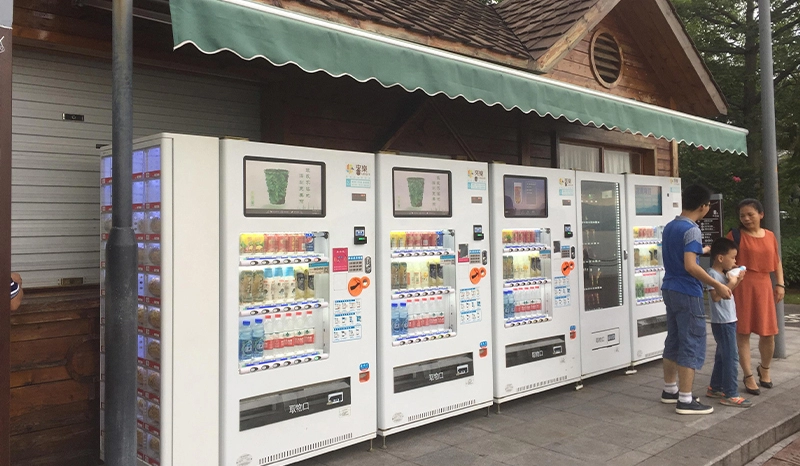
How to achieve real-time update of product information through vending machine display screen?
Learn More



A touch monitor used for several hours a day does not face the same demands as a display that remains active around the clock. In industrial control equipment, healthcare terminals, self-service systems, and other continuously operating devices, the display has to remain responsive and stable while also fitting into the mechanical structure of the equipment.
This is where the difference between an industrial LCD panel and a standard commercial display becomes important. The choice is not simply about screen size or resolution. For 24/7 touch operation, panel durability, operating stability, protection, touch responsiveness, and installation structure all need to work together. The Panel Mount Touch Monitor 10.1-23.8 Inches (3E Series) is designed around these requirements, combining an industrial-grade LCD panel with projected capacitive touch and a structure intended for equipment integration.
Commercial displays are generally developed for office, consumer, retail, or general-purpose environments. Their operating conditions may be less demanding, and the product design may prioritize appearance, multimedia functions, or cost-efficient mass-market production.
Industrial equipment has a different operating pattern. A control terminal or machine interface may remain powered throughout a production shift, operate continuously in multiple shifts, or be installed in a system where shutting down the display is inconvenient. Under these conditions, the LCD panel becomes part of the equipment's reliability chain.
An industrial-grade LCD panel is selected with longer operating life and more stable continuous use in mind. This is particularly relevant when the monitor serves as an operator interface. A display that remains readable and responsive over extended operation reduces the need for unnecessary replacement and helps maintain consistent interaction with the equipment.
The 3E Series uses industrial-grade LCD panels and is designed for stable 24/7 operation. Combined with multiple industrial protections, this makes the monitor better suited to embedded control systems and other equipment that cannot be treated like a conventional desktop display.
For a touch monitor, LCD performance alone is not enough. The touch layer must also respond consistently to repeated operator input.
The 3E Series supports projected capacitive touch with up to 10 touch points. This allows the interface to recognize multiple simultaneous contact points and provides sensitive, accurate touch detection. For industrial HMI applications, this can be useful when the interface contains gesture controls, multi-touch commands, or software functions that require more than simple single-point operation.
The touch panel and LCD panel are also optically bonded. This structure helps reduce the space between the touch surface and display and contributes to a clearer, more integrated viewing and touch experience. More importantly for equipment designers, the complete touchscreen structure works as a compact module rather than requiring the integrator to assemble separate display and touch components.
This is one reason an industrial touch monitor should be evaluated as a complete system. A commercial LCD may provide a suitable image, but that does not automatically mean its touch structure, mechanical design, and operating characteristics are suitable for industrial equipment.
Continuous operation often means exposure to conditions that are uncommon in a typical office.
Industrial control cabinets, terminal equipment, and public-facing systems may encounter dust, moisture, repeated operator contact, or temperature variations. The front surface therefore needs more than a visually attractive design.
The 3E Series provides IP65 front protection to help resist water and dust at the front of the monitor. The monitor also uses an industrial plastic front shell combined with an industrial black metal frame, creating a structure intended for equipment applications rather than ordinary desktop use.
Optional surface treatments can further adapt the display to different application requirements. AG, AR, AF, and antibacterial treatments are available depending on the project. These options allow integrators to consider factors such as glare, reflection, surface cleanliness, and the operating environment when configuring the monitor.
For a system that will be touched repeatedly throughout the day, these details can have a practical impact on usability and maintenance.
Another difference between a general commercial monitor and an industrial panel mount monitor is the way the display is integrated into the final equipment.
The 3E Series uses a precision compact-frame design. Its small-frame structure helps the touchscreen fit into equipment panels and cabinets without requiring excessive space around the active display area. On the rear casing, locking clips are positioned on each of the four sides for embedded installation. This allows the monitor to be secured to the front frame or panel while maintaining a balance between sealing and maintenance access.
The rear connections are also positioned to support installation. VGA, DVI, HDMI, DP, MIC, and AUDIO interfaces are located on the back and face downward. This arrangement can make cable routing easier when the monitor is installed inside equipment or against a mounting surface.
The available display interface combinations include VGA+DVI+HDMI and VGA+HDMI+DP, giving equipment designers more flexibility when matching the monitor to an existing host system.
The monitor also supports wall-mounted and desktop configurations through standard VESA mounting options. This means the same monitor platform can be adapted to different equipment structures instead of being limited to a single installation method.
Industrial equipment is often designed around existing mechanical dimensions rather than a completely new display enclosure. As a result, selecting the right screen ratio can be just as important as selecting the diagonal size.
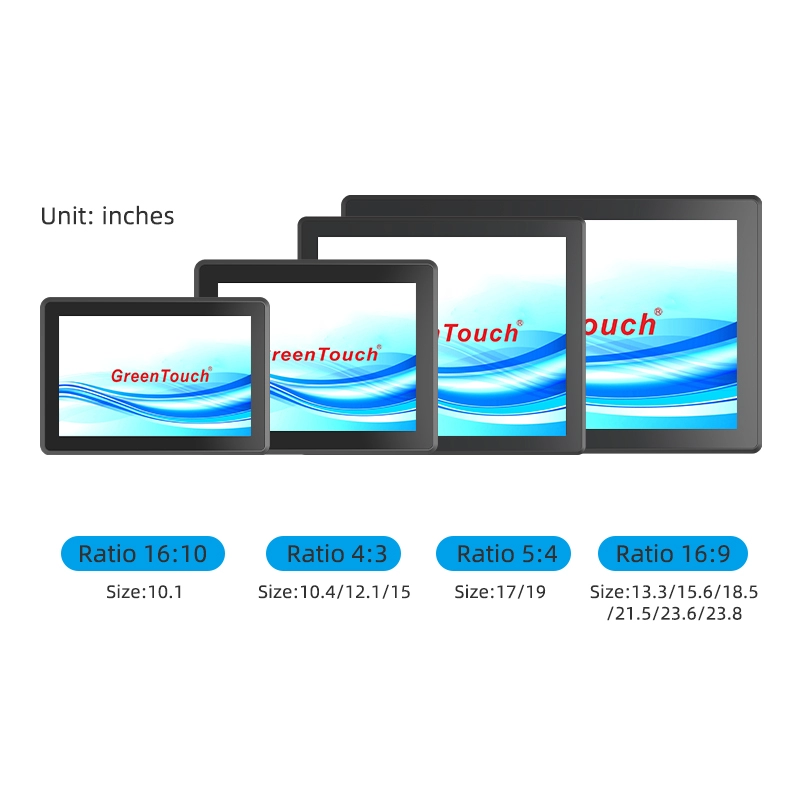
The 3E Series covers multiple aspect ratios, including 16:10, 4:3, 5:4, and 16:9. Available sizes range from compact 10.1-inch models to larger configurations, including 23.8 inches and other options in the series.
This range is useful for equipment manufacturers replacing an existing display or developing different control panels for different product models. A 4:3 or 5:4 screen may fit an older control cabinet more naturally, while a 16:9 display may be more appropriate for a newer interface or multimedia-oriented terminal.
Instead of forcing the equipment structure to accommodate one standard commercial display format, an industrial monitor series with multiple ratios gives designers more room to work with the existing mechanical layout.
For OEM and ODM buyers, the monitor itself is only one part of the sourcing decision. Consistent production capability, customization, quality control, and technical support can become equally important when the display is integrated into equipment that will be produced repeatedly.
ShenZhen GreenTouch Technology Co.,Ltd. specializes in touch products including capacitive and resistive touch screens, infrared touch frames, nano touch foil, touch monitors, touch all-in-one PCs, and digital signage products. The company operates an automated production line and enclosed dust-free workshop and has obtained ISO9001 and ISO14001 certifications.
Its R&D capabilities include more than 20 technical engineers, annual development of more than 50 new products, and more than 10 annual patents. GreenTouch also operates a Class 1000 dust-free lamination workshop supporting G+G, G+FF, and TP+LCM full lamination processes.
For touch monitor projects, this production background is relevant when customers need changes to the standard configuration. The 3E Series can be customized in areas such as screen size, logo, color, casing, and packaging, allowing OEM buyers to adapt the monitor to their own equipment or product requirements.
The distinction between industrial and commercial displays becomes clearer when the monitor is part of a larger machine or terminal.
For a basic office display that is used intermittently, a commercial monitor may provide everything required. However, when the display is expected to operate continuously, receive frequent touch input, remain installed in equipment, and withstand dust or moisture at the front, the requirements become different.
An industrial LCD-based touch monitor is particularly relevant for industrial control systems, HMI equipment, terminal accessories, smart healthcare equipment, and other embedded applications. In these situations, the monitor needs to be evaluated according to the complete application rather than by screen specifications alone.
The Panel Mount Touch Monitor 10.1-23.8 Inches (3E Series) brings these requirements together through industrial-grade LCD panels, 10-point PCAP touch, front IP65 protection, multiple industrial protections, compact-frame construction, flexible interfaces, and several mounting configurations. Its multiple size and aspect-ratio options also give equipment manufacturers more flexibility when developing or upgrading their systems.
For OEM projects where the display needs to function as a dependable part of the equipment rather than as a standalone consumer screen, these practical design details can make a significant difference. The 3E Series touch monitor provides a platform that can be adapted to different industrial equipment structures while maintaining the features needed for long-term 24/7 touch operation.