 RU
RU ZH
ZH IT
IT ES
ES TR
TR JA
JA PT
PT KO
KO FR
FR DE
DE AR
AR ID
ID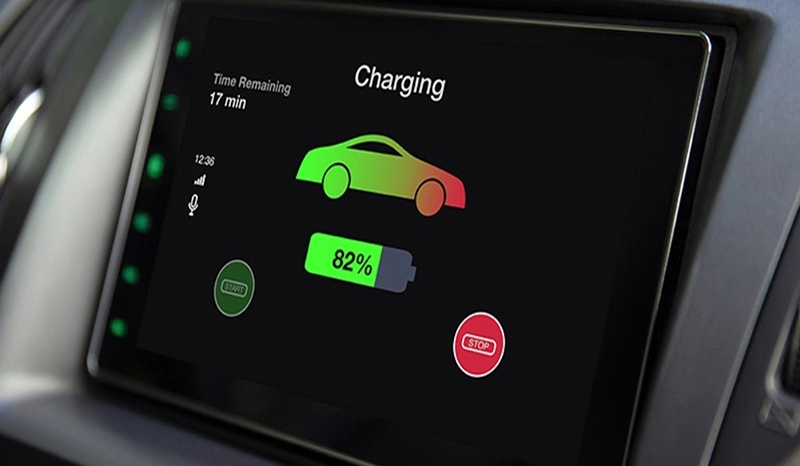
What is the development trend of charging pile display screens?
Learn More



When selecting a large interactive display for industrial equipment, retail systems, healthcare facilities, or smart transportation projects, the touch technology can have a direct impact on usability, installation, and long-term operation. Capacitive touch is widely used in smartphones, tablets, and compact interactive devices, but large-format displays often have different requirements.
For applications involving 32- to 65-inch screens, the comparison between infrared (IR) touch and capacitive touch should go beyond basic touch sensitivity. Factors such as multi-user interaction, screen size, installation structure, maintenance, operating environment, and continuous use also need to be considered.
The Wall Mount IR Touch Monitor 32-65 Inches (6C-IR Series) is designed around these requirements. Its 40-point infrared touch technology, wall-mounted structure, optical bonding, versatile connectivity, and industrial-grade operating capability make it a practical option for large interactive display applications.
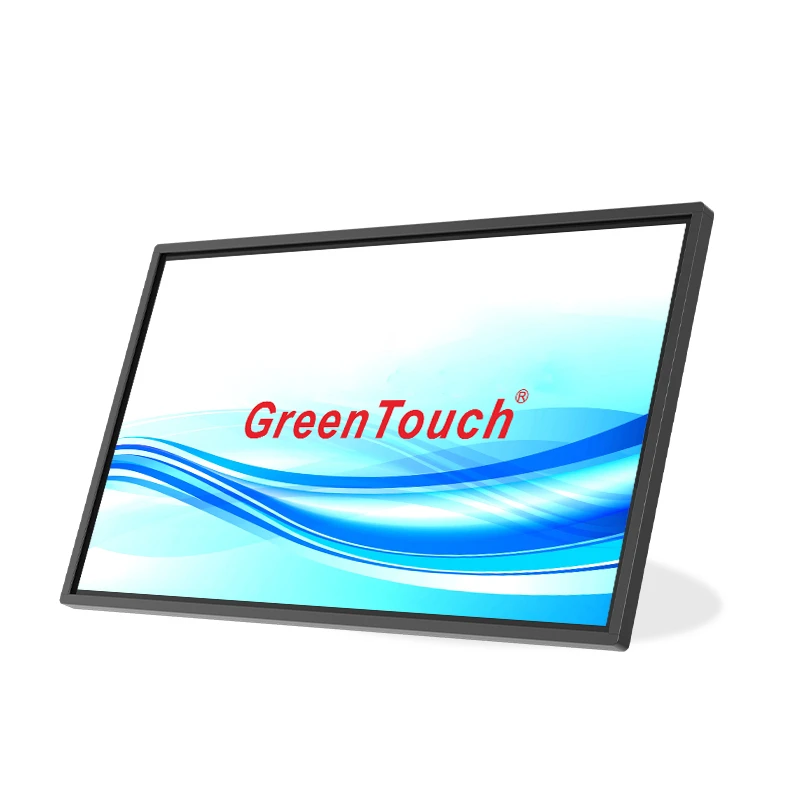
The requirements for a 55-inch or 65-inch interactive monitor are quite different from those of a smartphone or small embedded touchscreen.
A large display may be used by several people at the same time. In a smart retail environment, for example, customers may interact with product information while staff members operate the interface. In healthcare, a large screen may be used for patient information, medical visualization, or interactive communication. In industrial and intelligent manufacturing, operators may need to interact with dashboards or control interfaces while standing several feet away from the screen.
This is where touch technology becomes an important part of system design.
Capacitive touch detects changes in electrical properties at the touch surface. It can provide a highly responsive experience and is particularly effective for compact devices and applications where finger-based interaction is the primary requirement.
Infrared touch technology works differently. IR sensors create a touch detection field across the display area. When an object interrupts the infrared beams, the system can identify the touch position.
For large-format interactive displays, this architecture can provide useful advantages, particularly when the application requires multiple simultaneous touch points.
One of the most important characteristics of the Wall Mount IR Touch Monitor 32-65 Inches (6C-IR Series) is its support for infrared 40-point touch.
This capability is particularly relevant to large displays because the physical screen area is large enough for multiple users to interact with different parts of the interface simultaneously.
For example, a smart retail display could allow one person to browse product information while another interacts with a different menu. In a training or meeting environment, several users can interact with visual content without having to wait for a single touch point to become available.
The benefit is not simply a higher touch-point number on a specification sheet. On a large display, multi-touch capability can influence how the interface itself is designed. Applications can support gestures, simultaneous selections, collaborative content navigation, and more natural interaction between users.
For projects where the display is expected to function as a shared interactive surface, 40-point IR touch can therefore be a practical advantage over touch technologies designed primarily around individual finger interaction.
There is no universal answer because the right technology depends on the application. However, the differences become clearer when the display size and intended usage are considered.
Capacitive touch is often a strong choice when the system requires a familiar smartphone-like touch experience, compact construction, and highly responsive finger interaction. It is widely used in consumer electronics and smaller commercial touchscreens.
Large-format IR touch, on the other hand, can be advantageous when the screen is intended for shared interaction. The touch detection system is distributed around the display area, allowing large screens to support multiple touch points without relying on the same sensing structure used by small capacitive devices.
Another consideration is screen size. As a display becomes larger, the practical requirements for touch integration change. A technology that works extremely well on a 10-inch device should not automatically be considered the best solution for a 55-inch or 65-inch wall-mounted interactive monitor.
For industrial, retail, healthcare, and transportation systems, project designers should therefore evaluate the complete application rather than selecting touch technology based only on sensitivity.
Touch accuracy is only one part of a large interactive display. Users also need to see the content clearly and feel that the touch point corresponds naturally with what appears on the screen.
The 6C-IR Series uses an optically bonded touch panel and LCD panel. By integrating the touch layer and display more closely, optical bonding can help improve the visual relationship between the displayed content and the touch surface.
This is useful for interfaces that rely on precise selection. When a user touches a button, icon, map location, or control element, accurate positioning helps create a more direct interaction experience.
The monitor also uses a thin-bezel design, which allows more of the front surface to be dedicated to the display while maintaining a clean appearance for wall-mounted installations.
Interactive functionality should not come at the expense of image quality. A large touchscreen may be used to display dashboards, product information, maps, medical content, operating interfaces, or detailed visual materials, so screen performance remains important.
The 6C-IR Series supports 16.7 million or 1.07 billion display colors depending on configuration, with up to 90% NTSC color performance. For applications requiring broader color reproduction, the monitor can also offer a wide color gamut of up to 99% sRGB and 95% DCI-P3.
Color depth and accuracy are especially relevant when the screen is used for visual information rather than simple menu operation. Delta E (ΔE) can be used as a reference for evaluating color accuracy, while higher color depth helps reduce visible banding in gradients.
This combination of large-format viewing, high-resolution imaging, and interactive touch makes the monitor suitable for applications where users need both clear visual information and direct interaction.
A technically capable touchscreen can still become difficult to deploy if its connection layout is poorly designed.
The Wall Mount IR Touch Monitor 32-65 Inches (6C-IR Series) places its main connections on the rear of the monitor and directs them downward. Depending on configuration, available interfaces include HDMI, VGA, DP, DVI, MIC, AUDIO, HDMI 2.0, HDMI 1.4, DP 1.2, USB, and Type-C.
This downward-facing arrangement can make a difference when the monitor is mounted close to a wall. Cables can be routed more naturally without creating unnecessary interference behind the display.
The monitor can also be configured to automatically power on or off according to the presence of current or a video signal. For systems that are not continuously operated by a dedicated user, this feature can simplify daily operation and reduce unnecessary manual intervention.
The most suitable applications are those where a large screen needs to combine visual information with direct user interaction.
In industrial and intelligent manufacturing, a wall-mounted interactive monitor can be used for production dashboards, equipment interfaces, process information, and operator interaction.
In smart commerce and new retail, large touch displays can support product browsing, digital catalogs, self-service interaction, promotional content, and customer engagement.
Healthcare facilities can use large interactive displays for information access, visualization, communication, and other touch-based interfaces where screen size and intuitive operation are important.
Smart transportation is another potential application. Large interactive displays can be integrated into information terminals, control environments, public information systems, or transportation-related interactive equipment.
The common requirement across these scenarios is that the screen needs to function as more than a passive display.
For professional applications, operating stability is often more important than short-term specifications.
The 6C-IR Series is designed for extended operation, with a service life of up to 50,000 hours under normal operating conditions and support for 7×24 continuous operation. This is particularly relevant for equipment that needs to remain available throughout long working shifts or operate continuously in public and commercial environments.
For system integrators and equipment manufacturers, long operating capability can help reduce the need for frequent replacement and minimize interruptions caused by display downtime.
This makes the Wall Mount IR Touch Monitor 32-65 Inches (6C-IR Series) worth considering when the project requires a large interactive display that combines multi-touch capability with continuous-use performance.
The decision between IR and capacitive touch should ultimately be based on how the display will be used.
If the project prioritizes compact touch devices, familiar smartphone-style interaction, and a controlled finger-touch environment, capacitive touch may be appropriate.
If the project requires a 32- to 65-inch interactive display, multi-user operation, wall mounting, long operating hours, and flexible connectivity, infrared touch can offer a different set of advantages.
The right choice should also consider the number of simultaneous users, display size, installation method, interface requirements, operating schedule, and application environment.
For buyers and system integrators looking for a large-format IR touch solution, ShenZhen GreenTouch Technology Co.,Ltd. provides a broader manufacturing foundation behind its touch products. The company operates a Class 1000 dust-free lamination workshop and supports G+G, G+FF bonding, and TP+LCM full lamination technologies.
Its manufacturing operation includes a 5,000 m² standard production workshop and daily production capacity exceeding 600 touch panels. The company also maintains warehouse facilities in Huizhou and Shenzhen with a combined area of approximately 2,000 m² and storage capacity for up to 20,000 standard pieces.
For OEM, system integration, and commercial display projects, product specifications are only one part of supplier evaluation. Consistent manufacturing, engineering support, certifications, and customization capability can also influence project reliability.
ShenZhen GreenTouch Technology Co.,Ltd.has more than 20 technical engineers, develops more than 50 new products annually, and invests in new product development. Its certification portfolio includes CE, FCC, CB, RoHS, UL, CCC, and HDMI-related certifications, alongside ISO9001 quality management and ISO14001 environmental management system certification.
The company also reports more than 20 patent certificates, more than 30 computer software copyrights, and more than 60 other certificates.
For large interactive display projects, this combination of touch technology and manufacturing infrastructure can provide a more complete basis for evaluating a supplier.
The comparison between 40-point IR touch and capacitive touch should not be reduced to which technology is simply “more sensitive.” For large interactive displays, the more important questions are how many users need to interact with the screen, how large the display is, where it will be installed, how long it must operate, and what type of interface the application requires.
With 40-point infrared touch, optical bonding, thin-bezel construction, flexible connectivity, downward-facing ports, automatic power control, and 7×24 operating capability, the Wall Mount IR Touch Monitor 32-65 Inches (6C-IR Series) is designed for professional interactive applications across industrial manufacturing, smart retail, healthcare, and smart transportation.
For projects that need a large wall-mounted touchscreen rather than a conventional display, evaluating these practical requirements can help determine whether IR touch is a better fit than capacitive technology.